




3D printing is no longer an industry-exclusive technology but has become a tool with a real impact on modern medicine. In recent years, Hospitals, clinics, and research centres worldwide have incorporated additive manufacturing into their processes. to improve surgical planning, reduce risks, and offer increasingly personalised treatments.
Among all the applications of 3D printing in surgery, one of the most relevant is Manufacturing of custom surgical guides. These tools allow a digital surgical plan to be precisely transferred to the real patient, helping specialists to perform safer, more efficient, and predictable interventions.
But what exactly are 3D-printed surgical guides? How are they designed? In which medical specialities are they used? What advantages do they offer over traditional methods?
In this guide, we take an in-depth look at how 3D surgery is revolutionising medical practice and why more and more professionals are turning to 3D printing to improve their clinical outcomes.
What is a personalised surgical guide?

A surgical guide is a device designed specifically for a patient with the aim of assisting the surgeon during an operation.
Its main function is to serve as a physical reference for positioning instruments, making cuts, perforations or implants following the pre-operative planning exactly.
Unlike conventional guides, custom surgical guides are designed from real medical images of the patient, normally obtained by:
- CT (Computed Tomography)
- CBCT (Cone Beam Computed Tomography)
- Magnetic Resonance Imaging
- 3D anatomical scan
Thanks to this data, it is possible to create an accurate digital model of the patient's anatomy and manufacture a guide that is completely adapted to their clinical case.
3D printing allows these parts to be produced with extremely high precision and in very short timescales, something that is difficult to achieve with traditional manufacturing methods.
What is 3D surgery?
3D surgery is a surgical approach based on the use of three-dimensional models, digital simulations and personalised devices developed using 3D printing technologies.
The goal is transfer surgical planning from a virtual environment to the actual intervention with the highest possible level of accuracy.
3D surgery can include:
- 3D printed anatomical models
- Custom surgical guides
- Bespoke prosthesis
- Bespoke implants
- Advanced surgical simulations
Thanks to these tools, medical teams can anticipate difficulties, optimise procedures and tailor each intervention to the specific characteristics of each patient.
How are surgical guides manufactured using 3D printing
The manufacturing process for a custom surgical guide combines biomedical engineering, digital design and additive manufacturing.
1. Medical image acquisition

Everything begins with the acquisition of anatomical information from the patient. Depending on the clinical case, different imaging technologies are used:
- TAC
- CBCT
- Magnetic Resonance Imaging
- Intraoral scanners in dentistry
These images generate digital files that allow the patient's anatomy to be reconstructed in three dimensions.
2. Anatomical segmentation
Once the data is obtained, specialists identify and separate the relevant anatomical structures: bone, blood vessels, nerves, soft tissues, and lesions or tumours.
This process is called medical segmentation.
3. Virtual Surgical Planning
With the digital anatomical model, a complete simulation of the intervention is carried out.
The medical team can define:
- Implant position
- Drilling angles
- Cutting lines
- Resection zones
- Surgical pathways
This phase allows for the optimisation of the surgical strategy before entering the operating theatre.
4. Surgical guide design

Once the planning is validated, the personalised guide is designed.
The piece incorporates unique anatomical references which allow for precise placement on the patient.
Furthermore, you can include guide holes, depth stops, locating surfaces and fastening systems.
5. 3D printing manufacture
The guide is manufactured using high-precision 3D printing technologies.
The most used are:
- SLA (Stereolithography)
It offers excellent resolution and very precise surface finishes. It is one of the most widely used technologies for manufacturing surgical guides.
- MJF (Multi Jet Fusion)
Suitable for functional components requiring mechanical strength and dimensional stability.
- SLS (Selective Laser Sintering)
Allows for the fabrication of robust and complex parts without the need for supports.
6. Sterilisation and validation
Before being used in the operating theatre, the guide must exceed the cleaning protocols, validation and sterilisation established for medical devices.
Applications of 3D printing in surgery
The applications of 3D printing in surgery are becoming increasingly extensive. They are currently used in multiple medical specialities.
Maxillofacial surgery
It is one of the fields where additive manufacturing has had the greatest impact.
Surgical guides allow for:
- Correction of facial deformities
- Orthognathic surgery
- Mandibular reconstructions
- Tumour resections
The accuracy achieved significantly reduces the margins of error.
Dental implants
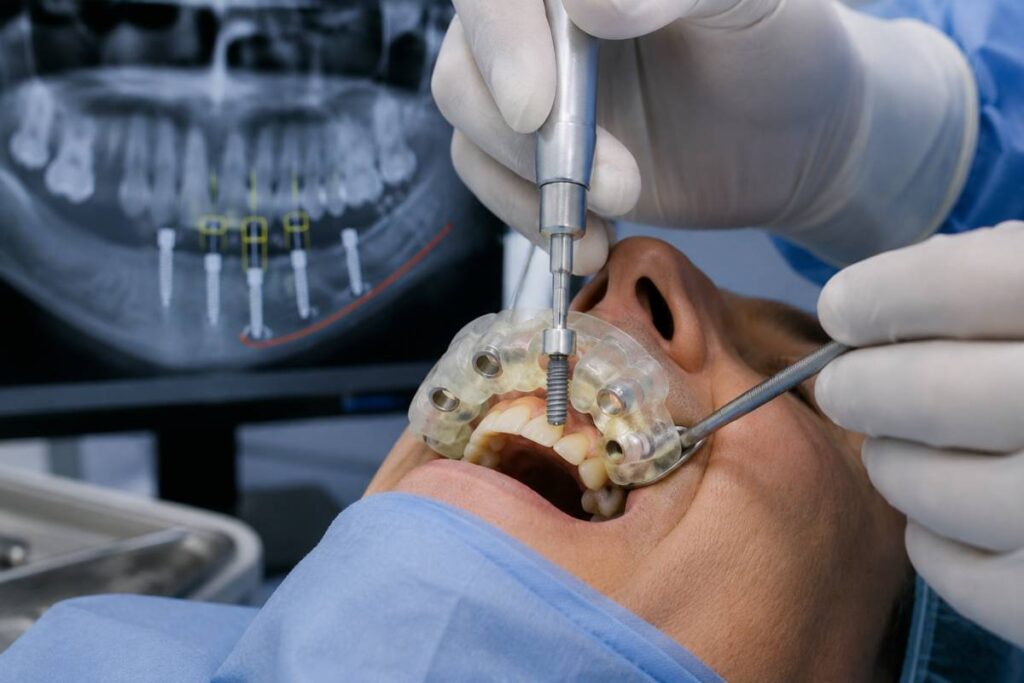
3D-printed guided surgery has transformed the Dental implant placement.
The guides allow each implant to be positioned exactly according to the digital plan.
Among its advantages are:
- Greater precision
- Less invasiveness
- Shorter surgical time
- Greater aesthetic predictability
Traumatology and Orthopaedics
3D printed guides facilitate complex procedures such as:
- Corrective osteotomies
- Bone reconstructions
- Knee surgery
- Hip surgery
They allow the intervention to be adapted to the specific anatomy of each patient.
Neurosurgery
Millimetre precision is critical in neurological procedures. Customised guides help to:
- Plan surgical trajectories
- Positioning instruments
- Minimising risks to sensitive structures
Cancer surgery
In oncology, 3D printing allows for the manufacture of guides for precise tumour resections.
This makes it easier:
- Healthy tissue preservation
- Best surgical margins
- Shorter intervention time
Cardiovascular surgery
Anatomical models and personalised guides help plan complex procedures related to:
- Congenital malformations
- Valve repairs
- Vascular interventions
Real-world cases: how 3D-printed surgical guides are improving clinical outcomes
One of the main benefits of custom surgical guides is that they allow for the execution on the patient of a plan previously made in a digital environment. Using medical imaging such as CT scans or MRIs, it is possible to design tools adapted to the specific anatomy of each person and use them during surgery to guide cuts, perforations, or the placement of implants.
This capability is especially valuable in complex trauma, orthopaedic, or maxillofacial surgery procedures, where small deviations can significantly affect the final outcome. Thanks to additive manufacturing, surgeons can work with devices designed specifically for each case, improving the accuracy and predictability of the intervention.
The experience of hospitals that have already incorporated 3D surgery into their clinical practice shows that these tools can help optimise surgical times and improve the execution of complex procedures. In this regard, the orthopaedic surgeon Frederik Verstreken, from AZ Monica Hospital (Belgium), it highlights that surgical guides allow for the exact reproduction of the previously made plan, stating that:
«Our accuracy is much greater when we use the guides than when we don't.
Beyond precision, 3D printing is contributing to the consolidation of increasingly personalised medicine, where surgical planning, the anatomical models and surgical guides are adapted to the unique characteristics of each patient, improving clinical decision-making and safety during surgery.
Advantages of 3D-printed surgical guides
The increasing adoption of this technology is due to the benefits it brings to healthcare professionals and patients alike.
- Greater surgical precision
The guide transfers an exact digital plan to the operating theatre.
This reduces variability associated with manual procedures.
- Shorter intervention time
By removing many of the intra-operative decisions, the procedure is faster.
Reducing surgical time can translate into lower costs and less anaesthetic exposure for the patient.
- Greater security
The guides help to avoid critical anatomical structures such as nerves, blood vessels, or sensitive organs.
- Less invasiveness
Precise planning allows for more conservative and less traumatic procedures.
- More predictable results
3D surgery improves the reproducibility of procedures and makes it easier to achieve established clinical objectives.
3D printing for anatomical models and surgical simulation
Beyond surgical guides, 3D printing enables the fabrication of actual patient-specific anatomical replicas.
These models are used for:
- Pre-operative planning
- Medical training
- Surgical simulation
- Patient Communication
The ability to physically hold an exact reproduction of the anatomy provides information that is often difficult to interpret solely through medical imaging.
The role of 3D printing in personalised medicine
One of the great advances in modern medicine is the personalization of treatments.
3D printing fits perfectly within this trend because it allows the manufacture of unique devices tailored to each patient.
Unlike traditional manufacturing, where standardised components are used, Additive manufacturing allows the production of customised surgical guides, bespoke prosthetics, personalised implants, specific anatomical models…
This improves the fit, functionality and clinical effectiveness of treatments.
Current challenges and limitations
Despite its advantages, the implementation of 3D printing in medicine still presents some challenges.
Among them are:
- Regulatory requirements
- Clinical validation
- Certification processes
- Initial implementation costs
- Specialised training
However, technological evolution is progressively reducing these barriers.
3D printing is redefining surgical precision
Custom surgical guides represent one of the most advanced and consolidated applications of 3D printing in medicine.
Its ability to transform medical data into physical devices tailored to each patient it is allowing for safer, more precise, and more efficient interventions.
From dental implantology to cmaxillofacial surgery, traumatology, or oncology, The applications of 3D printing in surgery continue to expand as the technology evolves.
In an increasingly personalised healthcare environment, additive manufacturing has become a key tool for improving surgical planning and optimising clinical outcomes, consolidating 3D surgery as one of the great revolutions in modern medicine.
At Additium3D helps companies and organisations in the healthcare sector to leverage the potential of additive manufacturing for the development of anatomical models, prototypes, personalised devices and innovative solutions. Discover how we apply 3D printing in medicine and healthcare.
3D printing is mainly used in surgery to manufacture anatomical models, personalised surgical guides, prosthetics and implants tailored to each patient. From medical images such as CT scans or MRIs, specialists can create three-dimensional models that allow for more precise planning of the intervention before going into the operating theatre.
Currently, the applications of 3D printing in surgery span specialities such as orthopaedics, maxillofacial surgery, dental implantology, neurosurgery, cardiovascular surgery, and oncology.
The cost of a 3D-printed prosthesis can vary considerably depending on the type of prosthesis, the materials used, the level of customisation, and the complexity of the design.
For example, a custom external prosthesis can cost from a few hundred euros, while advanced medical prostheses or custom implants used in surgery can reach several thousand euros due to design, certification, and manufacturing requirements.
The most important thing is that 3D printing allows for cost reduction compared to some traditional processes and facilitates the manufacturing of solutions that are fully adapted to each patient.
Yes. 3D-printed dental prostheses are safe as long as they are manufactured with biocompatible materials certified for dental use and in accordance with the protocols established by current health regulations.
Currently, dental laboratories and clinics worldwide use 3D printing technologies to manufacture splints, dental models, provisional crowns, surgical guides for implants, and dental prosthetics with high levels of precision and reliability.
Not necessarily. In many cases, 3D printing allows for the optimisation of manufacturing processes and a reduction in production times, which can translate into similar or even lower costs compared to some conventional methods.
Furthermore, digital manufacturing facilitates customisation and repeatability, allowing for the more efficient production of prostheses adapted to each patient.
3D-printed prosthetics offer numerous advantages, particularly in terms of customisation, precision, and manufacturing speed. By being designed from the patient's actual anatomical data, they can achieve a more precise fit and better functional adaptation.
However, the choice between a prosthesis manufactured by 3D printing or by other methods will depend on factors such as the clinical application, the required materials, and the specific needs of each patient.
The technology used depends on the medical application and the device requirements.
Among the most widely used are:
SLA (Stereolithography): widely used for manufacturing surgical guides, anatomical models, and devices that require a high level of detail.
Selective Laser Sintering (SLS): used to produce strong parts, anatomical models and certain custom medical devices.
MJF (Multi Jet Fusion): suitable for manufacturing functional components with high precision and excellent mechanical properties.
3D Metal Printing employee for the production of permanent titanium implants and other biocompatible alloys used in traumatology, maxillofacial surgery and orthopaedics.
The choice of technology always depends on factors such as biocompatibility, mechanical strength, the precision required and the end-use of the medical device.