




There is a fairly common problem in industry that often stalls more projects than might appear: one piece breaks... and it no longer exists.
It could be a component of an old machine, a specific casing, a bracket, a part from a discontinued system, or a spare part that's impossible to get because the manufacturer stopped producing it years ago.
And the worst thing is that often we're not talking about a large critical part. Sometimes a small part can completely stop a line, a machine or a piece of equipment.
Until recently, the options were quite limited:
- Search for used spare parts
- importing parts with eternal deadlines
- adapt solutions “as best as can be”
- or directly replace complete machinery
But the industrial 3D printing This scenario is changing a lot.
Today it is possible to reproduce many out-of-print parts quickly, functionally and economically viably, even if original plans do not exist.
And this is no longer something experimental. More and more companies are using additive manufacturing to solve real maintenance problems., business continuity and industrial replacement.
The real problem of discontinued parts
When a part disappears from the market, the problem is usually not solely the cost of the replacement.
The real problem is everything else it generates around it: Downtime, delays, production stoppages, supplier dependency, and loss of productivity.
In many industrial settings, continuing to use older machinery remains entirely profitable. The problem arises When a small component ceases to be manufactured and finding a replacement part becomes an impossible mission.
This happens a lot in:
- Industrial machinery
- Automotive
- production lines
- Technical equipment
- electronic systems
- tooling
- imported machinery
And this is where the industrial 3D printing That makes a lot of sense.
Because it allows parts to be manufactured on demand without the need for moulds, long runs, or reliance on the original manufacturer.
3D printing is not just for prototypes

There are still companies that continue to associate 3D printing solely with visual models or prototypes.
However, the reality is very different.
Current technologies allow the manufacture of:
- functional parts
- Technical components
- supports
- casings
- gears
- adaptors
- fastenings
- Fully operational industrial spare parts.
Furthermore, thanks to technical materials and industrial technologies such as MJF, SLS or SLA, many of these parts can withstand: mechanical stress, temperature, vibration, wear or continuous use.
This is why more and more companies are using additive manufacturing to solve industrial maintenance and replacement problems.
How to make a discontinued part using 3D printing
One of the biggest mistakes is thinking you need the original file of the piece.
Often it's not necessary.
There are currently several ways to reproduce an old or out-of-print piece.
3D scanning

If a physical piece still exists, even if it's broken or worn, it can be scanned to generate a digital model.
3D scanning allows for the highly accurate capture of geometries, dimensions, complex shapes, and technical details.
After, it is possible to correct and optimise that file before manufacturing the new part.
Reverse engineering
When original plans do not exist, the part can be digitally reconstructed from measurements and technical analyses.
This is very common in:
- Antique machinery
- industrial components
- classic vehicles
- Discontinued systems
In addition, mucho a veces puede incluso mejorar el diseño original.
For example, strengthen weak areas, reduce weight, optimise geometries or adapt the part to new needs.
Functional redesign
In some cases, it is not necessary to copy the original piece exactly.
The important thing is that it performs the same function.
Here, 3D printing offers a great deal of flexibility because it allows for the redesign of components, adapting them. for actual company use.
And that often It even improves performance compared to the original component.
Key steps to manufacturing a discontinued part
Although each project is different, the process usually follows these phases:
1. Piece analysis
First, one must understand:
- What function does it serve
- what forces does it withstand
- In what environment do you work?
- What level of precision do you need
It's not the same to manufacture a visual casing as a part subjected to vibrations or temperature.
2. Digitisation or modelling
The 3D file is generated by:
- scanned
- reverse engineering
- CAD modelling from scratch
In many cases this phase is used to correct defects or improve the original design.
3. Choice of technology and material
One of the most important steps.
The choice will depend on: strength, temperature, accuracy, finish, flexibility and end use.
Choosing the wrong material can cause the part to fail quickly, even if it's perfectly manufactured.
4. Manufacturing and validation
Once manufactured, the part is tested and validated in a real-world environment.
Often small iterations are made to adjust tolerances or improve behaviour before manufacturing the final version.
What kind of pieces are usually reproduced
Obsolete parts are already being manufactured for a vast number of industrial applications.
Some rather common examples are:
- Technical support
- plastic casings
- Tapas and covers
- gears
- ducts
- fastenings
- adaptors
- tooling
- Controls and buttons
- Connectors
- old machinery parts
- automotive components
- Hard-to-find spare parts.
Many times they are relatively simple but essential parts for a machine to keep running.
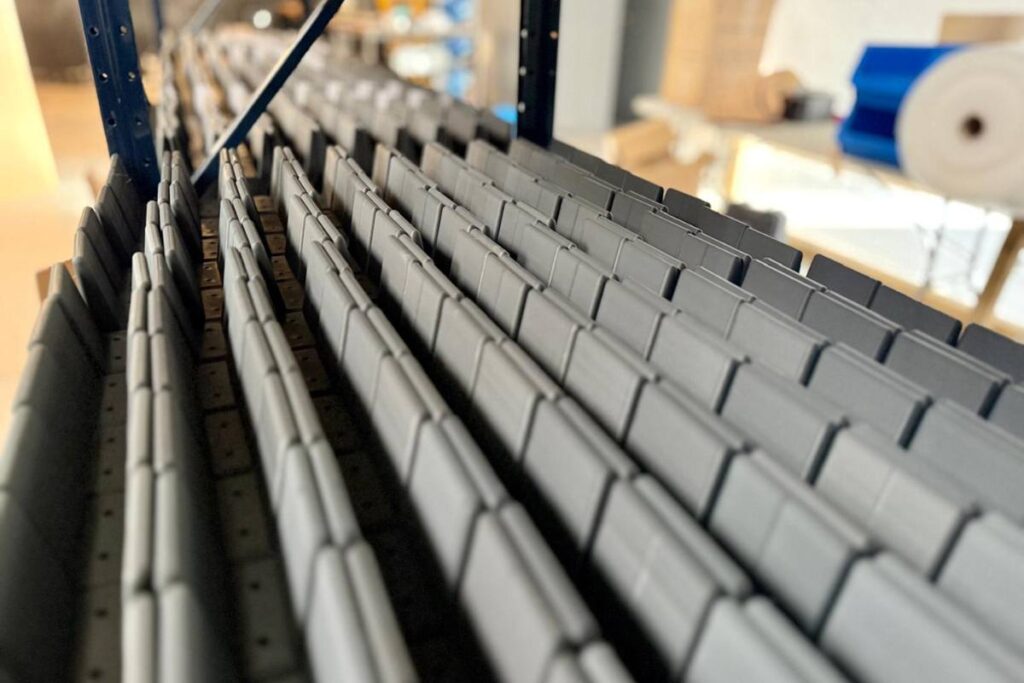
And there, additive manufacturing allows us to solve the problem much faster than trying to locate original spare parts.
How to choose the right technology and material for printing spare parts
Not all technologies serve the same purpose. Choosing correctly depends on the actual use of the part and the environment in which it will operate.
| Technology | Best for | Advantages | Limitations |
| FDM | Prototypes and basic functional parts | Economical, fast, and versatile | Less precise finish |
| SLA | Detailed parts and fine finishes | High visual accuracy | Lower mechanical strength |
| SLS | Technical parts and complex geometries | Very good resistance | Higher cost |
| MJF | Industrial production and functional parts | Precision, repeatability and speed | Industrial machinery required |
| Metal (DMLS/SLM) | Demanding metal components | Maximum resistance | High cost |
Regarding materials, some of the most commonly used ones at present are:
| Material | Common application | Features |
| ABS | Casings and mounts | Impact resistant |
| Polyamide 12 | Industrial parts | Very good mechanical strength |
| TPU | Joints and flexible parts | Elasticity and absorption |
| ASA CF | Outdoor and automotive | UV and weather resistance |
| PAHT CF | Demanding industry | High thermal and mechanical resistance |
Advantages and considerations before manufacturing a discontinued part
3D printing offers many advantages for these types of applications, but there are also important aspects that are worth considering before manufacturing.
Advantages
- Fast on-demand manufacturing.
- Possibility of reproducing impossible-to-find parts.
- Reduction of downtime.
- No mould needed.
- Possibility of improving the original design.
- Local and flexible production.
- Reduced dependence on external suppliers.
Important considerations
It is also important to take into account:
- Real working conditions
- temperature
- Friction
- tolerances
- mechanical loads
- Expected lifespan.
Not all parts can be manufactured with any technology or material.
That's why It is key to technically analyse each case before manufacturing.
It also allows for the improvement of parts that were constantly failing.
Many times the original parts had problems:
- weak areas
- geometries that are not very well optimised
- frequent cracks
- Upgradable materials
3D printing doesn't just allow for copying the part. It also allows it to be improved.
For example, by reinforcing certain areas, changing thicknesses, modifying geometries, or using more resistant materials.
This means that in some cases, the new part works even better than the original.
The big advantage: manufacturing on demand
One of the biggest changes that 3D printing introduces is that it's no longer necessary to store large quantities of spare parts.
Many companies are starting to work with Digital libraries, CAD archives and on-demand manufacturing.
In other words, The part is manufactured only when needed.
This greatly reduces: stock, storage, logistical dependence, and associated costs.
Especially for older machinery or rare parts, that makes a lot of sense.
If you want to delve deeper into 3D-printed spare parts, we've already discussed What types of spare parts can be manufactured with 3D printing, recommended materials, and real examples of industrial and automotive parts.
Do you need to manufacture a discontinued part or an industrial component?
At Additium3D we help businesses to manufacturing technical parts, industrial spare parts, and obsolete components using industrial 3D printing, adapting each project to real needs of use, resistance and production.
We work from scanning and modelling through to final manufacturing, selecting the most suitable technology and material for each application.
If you have a hard-to-find part, you need to reduce downtime, or you want to assess whether a solution can be manufactured with 3D printing, You can tell us your case here.
Frequently asked questions about discontinued parts and 3D printing
Yes. In fact, one of the great advantages of additive manufacturing is precisely customisation. Unique parts can be manufactured, adapted, or are impossible to find on the market, especially in old machinery, automotive, or industry.
Normally, the most profitable option tends to be:
Discontinued parts
Short series
Prototypes
tooling
customised parts
Components that are difficult to obtain through traditional manufacturing.
Especially when manufacturing moulds isn't economically viable.
It depends on the material and the technology.
In some industrial processes like MJF or SLS, some of the powder can be reused and recycled for future manufacturing.
Furthermore, there are increasingly more solutions focused on sustainable manufacturing and the reuse of materials.
Some of the most used software are:
SolidWorks,
Fusion 360,
CATIA,
AutoCAD,
Rhino,
FreeCAD.
The choice depends a lot on the type of part and the level of engineering required.
It depends on the complexity, size, and technology used. But in many cases, it can go from weeks of waiting to just a few days.
Yes. It is often used to:
reinforce weak areas,
optimise geometries,
lose weight,
to use more resistant materials than the originals.
Yes, it is becoming increasingly common to manufacture discontinued car parts using 3D printing, especially for classic cars, older models, or hard-to-find components.
They can be reproduced
supports,
casings,
trims,
fixings,
ducts,
Buttons,
Adapters,
or interior parts.
Furthermore, in many cases, certain weak points of the original design can also be improved by using more resistant materials or adapting geometries.
It's a fairly common situation, especially with older motorcycle models, imported models, or specific parts that the manufacturer no longer produces.
In many cases, 3D printing allows for:
reproduce broken parts,
Manufacture adapters,
Rebuild casings,
replicate components from the original part using 3D scanning or reverse engineering.
Especially for small series or hard-to-find parts, it can be a much faster and more economical solution than searching for second-hand spares.
Although additive manufacturing has a huge number of industrial applications, it can also be used to manufacture hard-to-find domestic parts.
For example, many people are currently looking for individual pieces of discontinued crockery, old remote controls, lids, brackets or small components that are no longer manufactured.
Depending on their use and the material required, many of these parts can be reproduced quite accurately using 3D printing.