




Choosing a material to manufacture a part using industrial 3D printing is not simply a matter of looking for the «strongest» material. A part may be subjected to tension, bending, impacts, temperature, wear or repeated deformation, and each of these conditions requires the evaluation of different properties.
Therefore, the appropriate material depends both on the characteristics of the part and on the actual conditions in which it is going to work.
At Additium3D we analyse these factors before defining the manufacturing solution. 3D printing technology, the material, the part's geometry and its conditions of use must be considered together in order to achieve a functional component that is suitable for the application.
In this article we review which properties should be prioritised according to the type of stress an industrial part will withstand y what materials might be suitable in each case.
What needs to be taken into account before choosing a material?
Before selecting a 3D printing material, it is advisable to define how the part is actually going to work.
Manufacturing a casing is not the same as making a structural part, a guide, a guard, a seal or a component subject to temperature. Among the factors that can influence the choice are:
- Mechanical loads: tension, compression, bending or combined stresses.
- Impacts: impacts or point loads.
- Temperature: operating temperature and occasional exposure to elevated temperatures.
- Wear: friction, continuous contact or repetitive motion.
- Rigidity: need to maintain geometry under load.
- Flexibility: ability to deform and regain its shape.
- Dimensional stability: need to maintain tolerances and geometry.
- Weight: especially important in applications where it is desirable to reduce mass.
- Working environment: moisture, external exposure, chemicals or other specific conditions.
Therefore, There is no single 3D printing material that is the best for all applications.
Selection must be based on the specific requirements of the piece.
Which 3D printing material is strongest?
This is one of the most common questions when considering the manufacture of an industrial part using additive manufacturing. However, speaking simply of «strength» can turn out to be too generic.
A part may require mechanical strength, rigidity, impact resistance or the ability to withstand elevated temperatures. Furthermore, the final behaviour also depends on the geometry, manufacturing orientation and the technology used.
Among the technologies and materials we work with at Additium3D, PAHT CF, Nylon 12 CF, PA12 S and ABS GF they can meet different functional part requirements and industrial applications.

The choice will depend on what type of stress the component has to withstand.
If the part is subjected to mechanical loads
When a part has to withstand loads during operation, it is important to assess properties such as mechanical strength, stiffness and dimensional stability.
In such cases, technical materials can be particularly useful, such as:
PAHT CF
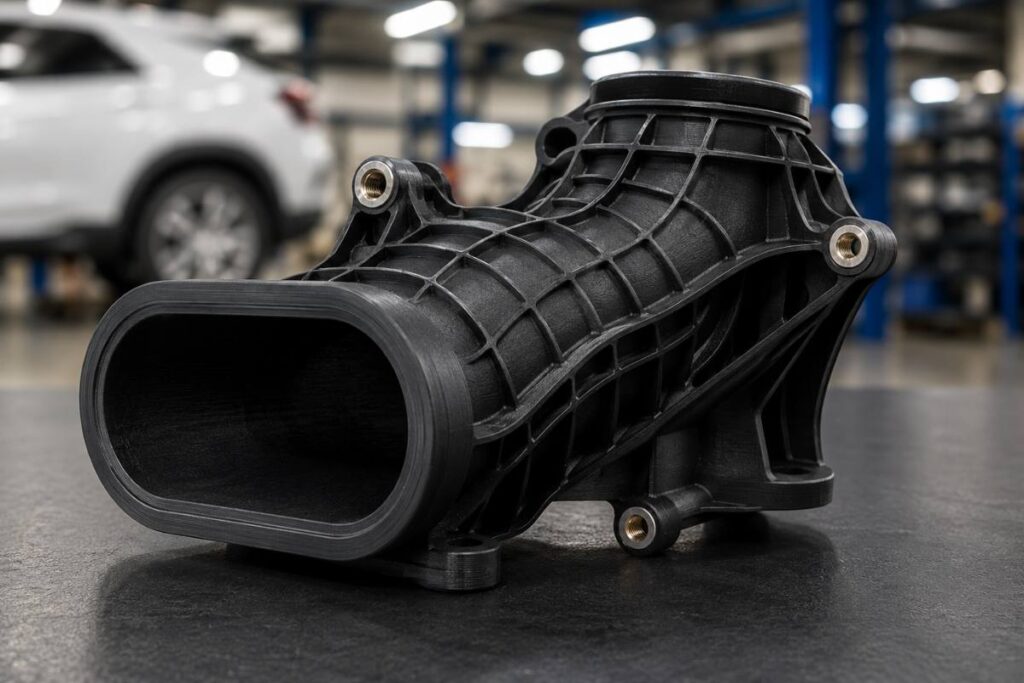
The PAHT CF combines a high-temperature polyamide with carbon fibre. It is designed for parts that require high mechanical strength, rigidity, dimensional stability and good performance at elevated temperatures.
It can be an option for functional components subjected to demanding loads.
Nylon 12 CF
The Nylon 12 CF it incorporates carbon fibre and is aimed at applications requiring a technical material with good mechanical performance.
It can be used to manufacture functional parts where the aim is to combine strength and rigidity with the advantages of additive manufacturing.
ABS GF

The ABS GF, reinforced with fibreglass, is an alternative for certain parts manufactured using FDM that require better mechanical performance than a standard thermoplastic.
Your choice will depend on the specific requirements of the application and the manufacturing process.
If the component is going to operate at high temperatures
Operating temperature is another factor that can rule out certain materials.
A part may have to work close to a heat source, be subjected to thermal cycles, or maintain its geometry and performance when the temperature increases.
In these cases, it is not enough to select a mechanically strong materialits thermal behaviour must be evaluated specifically.
PAHT CF for thermally demanding applications

PAHT CF is specially geared towards applications where the part must maintain good mechanical and dimensional behaviour under elevated temperature conditions.
This is why it can be an interesting alternative for certain industrial components subjected simultaneously to mechanical loads and thermal demands.
If the part is subject to impacts
When there is a risk of impacts or point loads, it is useful to assess the material's ability to absorb impacts without fracturing.
In this type of application, impact resistance may be more relevant than achieving maximum rigidity.
The choice will depend on the intensity and frequency of the impacts, the geometry, and the conditions of use of the component.
PA12 S, for example, it is a material used in industrial additive manufacturing for functional parts and may be suitable for numerous applications where a balance between mechanical performance, precision and component behaviour is sought.
If the part is subject to wear or friction
Not all industrial parts can withstand heavy static loads. Some work continuously in motion and are subject to contact, friction or wear.
In these cases it is advisable to analyse:
- frequency of the movement;
- contact type;
- pressure exerted;
- speed;
- temperature;
- estimated duration of the piece;
- and environmental conditions.
The material must be selected taking into account how wear is produced, not only its initial mechanical strength.
For certain functional parts of this type, technical materials such as PA12 S can be considered, Nylon 12 CF o ABS GF, always depending on the specific working conditions.
If the part needs to be flexible
There are applications where rigidity is precisely a problem.
Gaskets, guards, damping elements or components that need to deform require a material capable of withstanding that deformation without losing its functionality.
TPU: when the part needs to deform
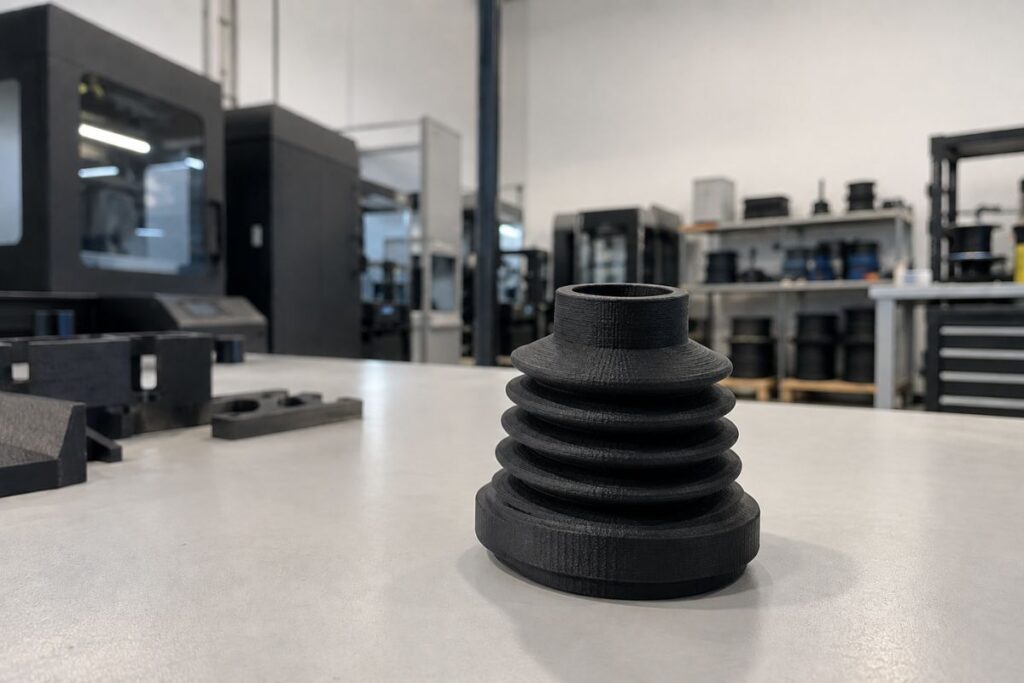
The TPU It is a flexible and durable thermoplastic polyurethane that allows the manufacture of parts with elasticity and deformation capacity.
In FDM 3D printing, it can be used to manufacture functional components that need:
- flexibility;
- shock absorption;
- deformation;
- wear resistance;
- or behaviour similar to that of certain elastomeric materials.
In this case, looking for the «most resistant» material wouldn't make sense: the property that defines the application is precisely flexibility.
If dimensional stability is the priority
In certain industrial applications, a component must not only bear a load: it must also maintain its geometry and dimensions during operation.
This can be especially important in:
- tools;
- cases;
- brackets;
- mounting components;
- parts with tolerances;
- elements that must fit with other components.
In these cases, the material, the manufacturing technology and the geometry must be assessed together.
Technologies such as MJF y SLS they allow the manufacture of complex functional parts in materials such as PA12 S, Nylon 12 or Nylon 12 CF, while, whereas FDM it can be a suitable alternative for other specific needs.
Does carbon fibre make a 3D-printed part stronger?
The incorporation of carbon fibre can significantly modify the behaviour of certain materials, especially in terms of stiffness and mechanical performance.
But more carbon fibre does not automatically mean it is the right material for every part.
The choice must take into account which property needs to be improved and how the component is going to work.
At Additium3D we work with reinforced materials such as PAHT CF and Nylon 12 CF, which can be useful when an application requires mechanical performance and rigidity superior to those that certain unreinforced materials can offer.
Comparison: which material to choose according to need?
| Need for the part | Materials to be assessed | Technology |
| functional parts for industrial use | PA12 S | MJF |
| High strength and mechanical performance | PAHT CF | FDM |
| Stiffness and mechanical performance | Nylon 12 CF | SLS |
| Reinforced technical parts | ABS GF | FDM |
| Flexibility and deformation | TPU | FDM |
| Prototypes and low-demand parts | PLA | FDM |
| High precision and detail | SLA resins | SLA |
This table should be interpreted as an initial orientation, not as an automatic selection of the material.
The definitive choice depends on the specific conditions of each project.
Material and technology: two decisions that go together
One of the keys to industrial additive manufacturing is understanding that material and technology should not be chosen first and independently afterwards.
Technology conditions the manufacturing process, performance, precision, possible geometry and available material options.
For example:
- MJF it allows the manufacture of functional parts and short or medium runs with PA12 S.
- SLS allows working with materials such as Nylon 12 and Nylon 12 CF and manufacturing complex geometries without traditional supports.
- FDM it offers a wide variety of technical materials, including ABS, ABS GF, PAHT CF, TPU and PLA.
- SLA it stands out particularly when detail, precision and specific surface finishes are required.
Therefore, when faced with an industrial part, the question should not simply be «what material is stronger?», but Which combination of technology, material and design best responds to the actual working conditions of this part?
How to choose the right material for an industrial part?
The process can be summarised in five steps:
1. Define the function of the part
What does it have to do? Is it a bracket, a housing, a guide, a guard, a fixture or a functional component?
2. Identify the efforts
It is necessary to determine whether it will be subjected to tension, compression, bending, impacts, vibrations, friction or repeated deformation.
3. Analyse the working conditions
Temperature, humidity, external exposure, contact with other components and any other relevant conditions may modify the choice.
4. Assess the necessary properties
Based on the working conditions, it is possible to determine whether the priority is strength, rigidity, flexibility, dimensional stability, thermal behaviour or wear resistance.
5. Select technology and material
With all this information, it is possible to assess which additive manufacturing technology and which material offer the most suitable combination for the project.
What if you don't know which material to use?
Precisely here is where technical advice becomes important.
In industrial additive manufacturing, there is not always a universal answer. Two seemingly similar parts may need different materials if they work under different conditions.
At Additium3D we analyse the application, the characteristics of the part and its requirements to determine which technology and material may be most suitable.
The objective is not simply to print the part, but find a manufacturing solution that responds to the company's real need.
Do you need to choose the right material for an industrial part?
If you have a part and you do not know which technology or material can offer the best result, English (UK) Additium3D we can help you evaluate the different options.
We analyse the characteristics of the part and its conditions of use to propose the most suitable additive manufacturing solution.
Tell us what you need to manufacture and we will look into the best alternative with you.
There is no single material that is the strongest for all situations. Strength must be analysed according to the type of stress, temperature, wear and the operating conditions of the part.
It depends on the temperature and operating conditions. For applications combining mechanical and thermal demands, PAHT CF, designed to offer good performance at elevated temperatures, can be considered.
It will depend on the load, geometry and working conditions. Technical materials such as PAHT CF, Nylon 12 CF, ABS GF or PA12 S may be options to consider depending on the project.
TPU is a suitable choice when the part requires elasticity, deformation and shock absorption.
Carbon fibre-reinforced materials can improve certain properties, especially stiffness and mechanical behaviour. However, their suitability depends on the specific requirements of the part.
It is advisable to jointly analyse the function of the part, the stresses it will undergo, the temperature, the wear, the tolerances and the available manufacturing technology.