

SLS technology
Selective Laser Sintering Service
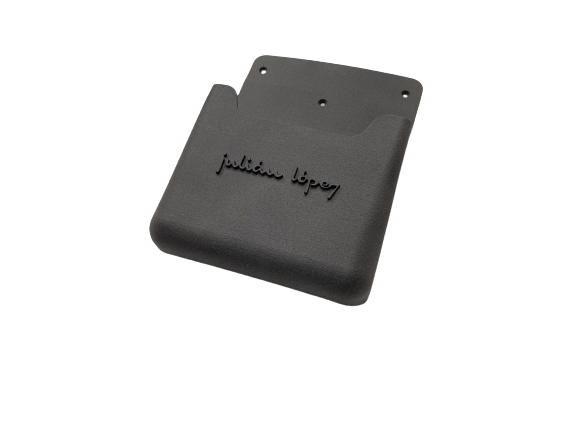
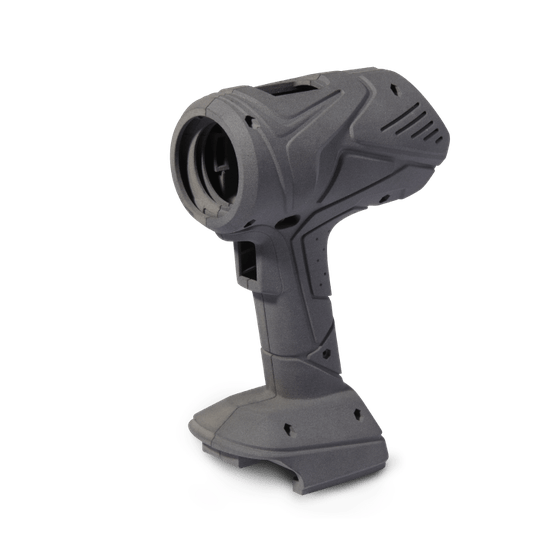
Ideal for short batches and parts with high strength and geometric complexity. Used in the aerospace and automotive industries for its ability to produce robust and precise components.
- One of the few in Spain with SLS 3D printing technology equipment in property.


SLS 3D Printing Case Studies - Nylon12
What is SLS 3D printing?
Manufactures thousands of parts in the time it takes you
SLS 3D printing allows the creation of both prototypes and parts intended for use in a final product. It consists of the laser synthesis of a plastic material, mainly Nylon, which is deposited in thin layers of powder that in turn act as a support, allowing for great geometric complexity.
The parts have isotropic mechanical properties, comparable to those of the same injection moulded material.


Advantages and disadvantages of SLS 3D Printing
We want to help you
to make informed decisions
Advantages of SLS Technology
- Final products: The greatest advantage of SLS technology is that it offers us the possibility of taking advantage of the virtues of 3D printing when creating unique, personalised and detailed prototypes, but with the characteristics of a final product. That is to say, with very good resistance to atmospheric agents and loads, at very competitive prices.
- Media-free printing: One of the wonders that SLS technology brings us compared to its competitors, and that anyone who has experience with 3D printing will appreciate, is that there is no more headache with the supports. This saves material, avoids marks and simplifies the process.
- Productivity: Maximisation of the volume of work leading to increased productivity, reduced production times and therefore the possibility of offering very competitive prices.
Disadvantages of SLS Technology
- CostlySLS technology tends to be expensive, both in terms of equipment and materials, which makes it less accessible to some companies. However, at Additium 3D we offer very competitive prices.
- Printing time: SLS printers can have longer print times compared to other technologies.
- Post-processing required: Post-processing is often required to clean and smooth the printed parts, which can add additional time and cost.
- Requires technical expertise: The use of SLS may require advanced technical knowledge to set up and operate the printers efficiently.
LET'S TALK
Choose how to contact
Talk with Addit-IA
Get quick answers on industrial additive manufacturing thanks to our artificial intelligence trained with Additium 3D expertise.
Schedule your free consultation
Book a call with me and tell me about your project: I will guide you without obligation on how to optimise your production with 3D printing.
SLS TECHNOLOGY
Very high quality 3D print finishes with SLS technology


What materials are used in SLS 3D printing?
This is fundamental to understanding this technology, as the range of options is not as wide as we will see in FDM or SLA.
Nylon
The most common material for selective laser sintering is nylon, a high-capacity engineering thermoplastic that is used for both functional prototypes and end-use production. Nylon is ideal for complex assemblies and durable parts, featuring many good properties such as:
- Its robustness and rigidity, which makes it highly resistant to impact and fatigue.
- Its high environmental stability allows it to offer high resistance to changes in temperature and humidity, UV radiation, water and other solvents.
- Its biocompatibility, which allows it to be part of wearable technology and to be used in many contexts.
Nylon 12
Within the range of products that Formlabs offers in its FUSE 1, Additium 3D currently works with Nylon 12 Powder, the most versatile of the Formlabs range. Delving a little deeper into Nylon 12 and what we can offer you for your parts and prototypes, we are going to detail some of the mechanical characteristics it offers:
- Tensile breaking strength: 50 MPa
- Tensile modulus: 1850 MPa
- Bending temperature under load at 1,8 MPa (°C): 87 °C
- Bending temperature under load at 0,45 MPa: 170 °C
- Elongation at break X/Y (%): 11 %
- Elongation at break Z (%): 6%
Nylon Powder 12CF
With higher stiffness and strength than Nylon 11 - which offers more flexible products - and Nylon 12 and therefore higher cost.
This material combines the high strength and durability properties of nylon with the addition of carbon fibres, making it an ideal choice for robust, lightweight parts. It is widely used in aerospace and automotive applications due to its excellent strength-to-weight ratio and dimensional stability.
TESTIMONIALS
Customer stories

"One of the few companies that is a pleasure to work with. Thank you for your services. I will certainly continue to use your services (...)".
Néstor Grande
Art Director at Montiego


ADDITIUM 3D has done some exceptional printing work for me. They scanned my parts and printed them in superior quality.
They have also printed pieces downloaded from public libraries which have been very useful for my models and scale models. They are fast in execution and delivery.
Paco Niederleytner
Founder
Order received correctly. They were able to capture exactly the idea I asked for. Everything perfect and very friendly!
Maria Pallas
Founder
Spectacular work and treatment. Couldn't have looked better!
Alberto Artola
Founder
Frequently asked questions
FAQS 3D PRINTING SLS
Selective laser sintering (SLS). And it means, as detailed by what, in our view, is the benchmark for this technology, Formlabsis an additive manufacturing technology that uses a laser to sinter small particles of polymer powder into a solid structure based on a 3D model“.
Every 3D Printing process starts with the design of the 3D Model and its export to .STL format to be able to work from the FormLabs printing platform. By not having to create supports, thanks to the advantages of SLS technology, the only concern is to find an optimal Compaction Density to reduce printing time and save as much material as possible.
Once everything is ready on the platform, we simply connect the Build Chamber to the printer, fill the powder tank with the required amount of powder and the machine will do the rest for us until the printing is complete.
The big difference of SLS Printing is the post process necessary to obtain the highest possible quality in the prototypes and printed parts, and that is one of the differentiating factors between a normal printing service, and a high quality one like Additium3D. This process begins first with the transfer of the Build Chamber to the Shift, where the extraction of the printing cube, the cleaning of the parts and, something fundamental and a difference thanks to Formlabs, the recycling of the unprinted powder is carried out.
After carefully cleaning the parts, we could finish the process and consider the printing as finished and the prototypes as definitive; but in Additium3D we like excellence and that is why we go one step further, treating the parts with a sandblaster. Thanks to this last step, in which we apply a pressurised sandblasting to each part and prototype, we achieve total cleanliness and a much smoother and perfect finish of the print.
SLS (Selective Laser Sintering) printing uses a high-powered laser to selectively heat and fuse layers of powdered material, usually polymers, into a bed of powder. The process is repeated layer by layer, fusing the material together to create the desired three-dimensional part.
SLS technology is versatile and can utilise a variety of materials, including plastics such as polyamide (nylon), aluminium powder, glass powder, ceramics and composite materials. This makes it suitable for a variety of applications in industries such as automotive, aerospace and medical.
Well, it's no exaggeration to say that practically anything you can think of! As in everything, there are optimal options for each technology, but the versatility of Laser Sintering allows us to offer good detailed finishes, resistance to impact, fatigue and atmospheric agents, and very competitive prices, which make it the best option to manufacture your prototypes.
And with Additium3D you can now have it at your fingertips, with tremendous ease from our Model Calculator (which we taught you how to use in the previous blog), with unbeatable prices within the sector and the best possible post-processing, so that your parts and prototypes have the best conditions.