



Additive manufacturing offers multiple technologies capable of producing high-quality functional parts. However, when seeking robust industrial components, two of the most commonly used options are HP Multi Jet Fusion (MJF) y SLS (Selective Laser Sintering).
Both work with powdered materials, allow the manufacture of complex geometries without supports, and produce finished parts ready for use. At first glance, they may appear to be very similar technologies, but there are important differences that influence the finish, productivity, cost, and most suitable applications for each.
In this comparative guide, we analyse MJF versus SLS, explaining their advantages, differences, and when to choose each technology based on your project's needs.
What is MJF technology?

Technology Multi Jet Fusion (MJF), developed by HP, manufactures parts by depositing fusion and detail agents onto a bed of polyamide powder, which is subsequently fused using thermal energy.
This process allows for the manufacture of parts with high precision, excellent mechanical properties, and a high production speed, making it one of the most widely used technologies for short and medium production runs.
At Additium3D, we work with HP Multi Jet Fusion to manufacture high-quality functional components for multiple industrial sectors.
If you want to understand in depth how this technology works, you can consult our page on HP Multi Jet Fusion (MJF) technology.
What is SLS technology?
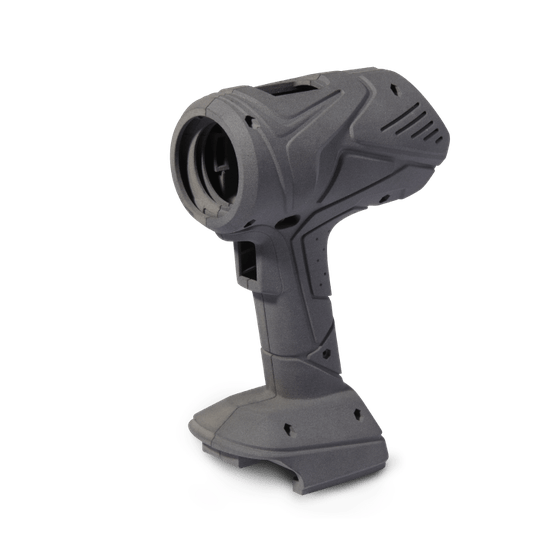


Technology SLS (Selective Laser Sintering) uses a high-power laser to selectively sinter powder particles, building the part layer by layer.
Like MJF, it does not require support structures, which allows for the manufacture of very complex geometries and optimises the use of manufacturing volume.
It is a technology particularly valued for functional prototypes, technical parts, and components where a high degree of design freedom is required.
MJF vs SLS: principales diferencias
Although both technologies share many characteristics, there are important differences worth knowing before choosing one over the other.
Manufacturing method
The main difference between MJF versus SLS It's the way they fuse the material.
MJF apply chemical agents and heat to the entire dust layer.
SLS uses a laser that scans the surface, sintering only the necessary areas.
This difference influences the manufacturing speed and the final finish of the parts.
Production speed
If the goal is to manufacture large quantities of parts in the shortest possible time, MJF typically offers higher productivity.
By working on entire layers rather than scanning each section with a laser, manufacturing times can be considerably reduced.
For this reason, it is a widely used option for mass production.
3. Surface finish
One of the most visible differences between MJF and SLS it is the surface finish.
Parts manufactured by MJF they usually present a more uniform and homogeneous surface.
The pieces SLS they tend to offer a slightly rougher texture, although they continue to provide excellent quality for industrial applications.
4. Dimensional accuracy
Both technologies offer high accuracy.
So much MJF how SLS they are capable of manufacturing complex components with very tight tolerances, so the choice will depend more on the type of application than on precision itself.
5. Mechanical properties
The two technologies produce strong parts suitable for functional applications.
However, the choice of material plays a much more important role than the technology itself.
For example:
MJF usually works with PA12 S, a very balanced material for industrial production.
SLS allows manufacturing parts with Nylon 12 o Nylon 12 CF, broadening the options when seeking specific properties such as greater rigidity.
6. Design Freedom
In this respect, it's practically a draw.
So much MJF how SLS allow manufacturing:
- Complex geometries.
- Internal ducts.
- Grids.
- Integrated hinges.
- Assembled parts.
- Optimised lightweight components.
All of this without the need for supports.
When to choose MJF?
Technology HP Multi Jet Fusion is usually the best option when looking for:
- Production of short and medium-length series.
- High productivity.
- Excellent repeatability.
- Very uniform finishes.
- Continuous industrial manufacturing.
- Ready-to-use functional parts.
It is especially recommended for companies that need to manufacture components recurrently with short deadlines.
When to choose SLS?
Technology SLS it is particularly interesting when the project requires:
- Maximum design freedom.
- Specific materials such as Nylon 12 CF.
- Structural components.
- Advanced functional prototypes.
- Especially complex geometries.
It is also an excellent option for validating designs before starting production.
MJF vs SLS: Which technology offers better results?
There is no single answer.
The best technology will always depend on factors such as:
- Quantity of pieces.
- Required materials.
- Mechanical properties.
- Surface finish.
- Cost.
- Delivery time.
- Final application.
In many projects, both technologies can offer excellent results.
The difference lies in which offers greater value for the specific needs of the piece.
How to choose between MJF and SLS?
Before deciding between MJF versus SLS, It is worth answering some questions:
Will the piece be a prototype or a final product?
Does it need to withstand high mechanical loads?
What surface finish does it require?
How many units are going to be manufactured?
Which material offers the necessary properties?
Answering these questions allows for the selection of the most appropriate technology from the outset, optimising both the project's cost and performance.
Here at Additium3D, we help you choose the right technology.
To choose between MJF y SLS it doesn't depend solely on the printer, but on the behaviour the part must offer once manufactured.
At Additium3D, we analyse each project to recommend the technology and material that best suit your mechanical, dimensional and functional requirements.
If you have doubts about which process to use, Our team can advise you on finding the most efficient solution.
It depends on the application. MJF usually stands out for its productivity and surface uniformity, while SLS offers great material versatility and design freedom.
In general, HP Multi Jet Fusion offers reduced production times for short and medium runs.
Both technologies produce very strong parts. The final properties primarily depend on the material used and the intended use of the part.
At MJF it is usual to work with PA12 S, whilst in SLS materials are used such as Nylon 12 y Nylon 12 CF, among others.
Both MJF and SLS allow for the manufacturing of final parts. The choice will depend on production volume, the required material, and the performance the component needs to offer.