


The sector of the Drones and UAVs (Unmanned Aerial Vehicles) It has become one of the areas in which we are specializing the most at Additium3D.
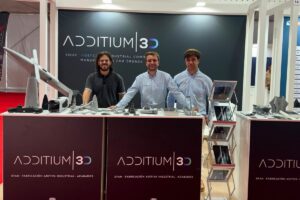
Last September we participated in a specialized fair for drones and UAVs, where we present our capabilities in design and manufacturing plastic components for UAVs through industrial additive manufacturing.
For the occasion, we developed our own UAVs and prepared a specific technical dossier. This allows us to showcase real applications, parts, and solutions without depending on customer projects subject to confidentiality.
Currently we have 7 UAV programs underway and a production capacity of more than 1,500 m² of floor space, more than 100 printers and four additive manufacturing technologies: MJF, SLS, FDM and SLA.
Why additive manufacturing is particularly well suited to the UAV sector?

Developing a UAV requires more than just manufacturing a sturdy piece of hardware. Weight, geometry, development times, customization, and the ability to quickly modify the design are fundamental factors.
Additive manufacturing allows you to go directly from the digital file to the part, without the need to develop a mold for each new geometry. This allows test, validate, modify and re-manufacture in much shorter cycles.
At Additium3D we work with first batches that, depending on the project, can be manufactured in 3-6 days. This allows for numerous iterations during the time that other processes need to develop the initial tooling.
But speed is only one of its advantages. Additive manufacturing also allows for on-demand production, avoiding minimum quantities, customizing components, and fabricating difficult or outright impossible geometries using conventional processes.
Manufacturing of plastic components for drones and UAVs
Working with different technologies allows us to address very different components within the same project:
- Fuselage and deckhouses.
- Cases and housings.
- Frames and structural components.
- Mounts for cameras, sensors and electronics.
- Accommodation and fixing systems.
- Internal components.
- Hoses and parts with complex geometries.
- Functional prototypes.
- Tools and assembly tools.
- Series of plastic components.
The goal is not to 3D print a part that was previously manufactured in a different way without modifying it. The true potential comes when We design from the beginning with the idea of how it will be manufactured.
H-Wing: a UAV designed for additive manufacturing from the very first moment

In order to be able to openly teach everything we can do in this sector, in August we developed H-Wing, A proprietary UAV with its components manufactured using MJF technology.
H-Wing was not simply conceived as a 3D printed drone. It was designed from the beginning with the possibilities and constraints of additive manufacturing in mind.
One of the best examples is its fuselage.
The walls have thicknesses of just 0.5-0.7 mm. If a section is observed separately, it can be flexed, deformed, and subsequently restored to its original position.
How can it then be part of the structure of an UAV?
Because each element serves a different function. The Polyamide 12 it provides the geometry and serves as a support for the various components, The carbon rods and mounting provide the necessary rigidity to the entire structure, which can be integrated directly into the fuselage itself.
The result is a structure that is used only the necessary material where it is really needed.
This ability to work with walls up to 0.5 mm has been manufactured and verified by the Additium3D team itself.
Less parts thanks to the integration of functions
The photographs of the H-Wing parts allow us to appreciate another advantage of designing specifically for the MJF: many elements that would normally be separate parts can be directly part of the fuselage.
Accommodation, wire ropes, tensioners and mounting points are printed in integrated with the geometry itself.

This allows for the reduction of separate parts, fasteners, and subsequent assembly operations. The project dossier shows precisely how housings, cable trays, and internal wiring can be integrated into a single component.
It's not just about lightening a piece. It's about Redesigning the assembly to require fewer components.
Designing also thinking about how it will be produced
Another interesting aspect of the H-Wing is that the design doesn't end when we get the drone to work.
We also think about how to manufacture as many components as possible in each production cycle.
Each section of the H-Wing is designed with the MJF manufacturing chamber in mind, 380 × 284 × 380 mm, By allowing some pieces to nest within others, they can take advantage of the available volume.
The result is especially significant: In the same mold we can manufacture the corresponding references for two complete H-Wings.
This turns the design of the part and the production planning into two parts of the same process. We not only seek to manufacture a component that works; we seek to ensure that it can be manufactured efficiently when the project needs to scale up.

MJF and FDM: every piece in the technology you need
At Additium3D we do not try to manufacture everything using a single technology. We work with MJF, SLS, FDM y SLA and we select the process based on the actual needs of each component.
Within our UAV projects, MJF and FDM play a particularly important role.
Technology HP Multi Jet Fusion with PA12 S It is particularly interesting for complex geometries, thin walls, integration of functionalities and components where we need repeatability and good mechanical performance.
For larger parts and simpler geometries, FDM It may prove to be a more suitable alternative.
One example is our internal development SAETA AX-1, a VTOL quadcopter in which we combine a structure manufactured using FDM with ABS-GF and internal and mounting components using MJF with PA12 S.
This combination sums up our way of working well: not adapting the part to the technology we have, but choosing the technology the part needs.
DFAM: less weight, less material and fewer components
Additive manufacturing offers its full potential when design and manufacturing are considered together.
Through Design for Additive Manufacturing (DfAM) We can optimize geometries, eliminate unnecessary material, consolidate components, and introduce structures that would be very difficult to obtain using conventional processes.
In another of our UAV developments we applied topological optimization to achieve a Complete frame of 129 g manufactured using MJF in PA12 S. The geometry itself distributes the material according to the structural requirements of the component.
In a UAV, every gram that we eliminate must have a technical justification. The goal is not simply to make the part thinner, but to achieve that Every material and every structural element does exactly the job it is supposed to do..
From the archive to serial production
Additive manufacturing doesn’t have to remain limited to prototypes.
One of the goals of our internal developments is precisely to demonstrate that we can move from design and early iterations to a recurring production of components for UAVs.
The process can start with a few units to validate the design and grow later without the need to make an initial investment in molds. In MJF, in addition, production can scale by leveraging the volume of manufacturing and increasing the number of cycles or cubas.
Our process begins by protecting project information through NDA. After analyzing the files, we recommend technology and materials, manufacture the first batch, and once validated, we can establish the required production schedule.
Additium3D, an additive manufacturing partner for the UAV sector
Our participation in this fair is part of a broader commitment to the sector.
We want to position ourselves Additium3D how Manufacturer and technical partner for companies that design and develop drones and UAVs, From the early engineering phases to the repeated manufacturing of plastic components.
Having our own projects like H-Wing allows us to experiment, validate solutions, and demonstrate with real parts what we can do.
And, above all, it allows us to apply that knowledge to our clients' projects: less material, fewer parts, designs optimized for manufacturing and production capable of scaling up when the project requires it.
Are you developing a drone or UAV and need to manufacture plastic components?
Tell us what you need to manufacture. We will analyze your parts to determine which technology, material, and manufacturing strategy best suits your project.
Additive manufacturing can be used to produce numerous components of an UAV, such as fuselage, deck, chassis, housing, electronic support, cameras and sensors, enclosures, fixing systems, internal components and assembly tools. The technology and material must be selected according to the geometry, loads, weight, dimensions and function of each piece.
Additive manufacturing allows reduce development times, perform rapid iterations, manufacture without molds, reduce weight, integrate multiple functions into a single part, and produce on demand. It also facilitates the transition from initial units to series without making an initial investment in equipment.
It depends on each component. In Additium3D we mainly use MJF with PA12 S for complex, functional parts with thin walls or multi-unit productions, While FDM may be more suitable for larger components and simple geometries, we also work with SLS and SLA when the project's characteristics require it.
Yes, provided that the design, material, and application requirements are suitable. In the H-Wing developed by Additium3D, components have been manufactured using MJF walls up to 0.5 mm thick, By integrating accommodations, overhead cables and wires within the pieces themselves.
One of the main materials used is PA12 S, Especially for functional components manufactured using HP Multi Jet Fusion. For certain larger parts and simple geometries, we also use ABS-GF using FDM, As in the internal development of the SAETA AX-1.
No. Additive manufacturing can be used both during the design and prototyping and validation for the recurrent manufacture of components. At Additium3D, we work from the initial units to series production, without the need to develop molds and being able to adapt the production cadence to the needs of the project.
The Design for Additive Manufacturing (DfAM) It allows to design specifically for additive manufacturing, eliminating material where it is not necessary, integrating functions and creating optimized geometries. Additium3D has, for example, developed a topologically optimized UAV frame 129 g manufactured using MJF in PA12 S.
Yes. Confidentiality is part of the work process. In UAV projects, Additium3D can sign an NDA before receiving the project files or specifications and does not publish photographs, names, or client data without permission.
The technical team can start from the 3D files of the parts To study geometry, requirements, quantities, and application. Based on that information, the most suitable technology and material are recommended, and the manufacturing proposal is prepared.
Yes. Some examples of additive manufacturing are the production of functional prototypes, tooling, housings, supports, structural components, parts with internal channels, short series and customized components. In the UAV sector, Additium3D uses it to manufacture everything from fuselages and wings to frames, housing for electronics, and internal components. The H-Wing, for example, is an UAV developed by Additium3D whose parts have been manufactured using MJF technology.
In Spain, there are different companies dedicated to the design and manufacture of drones and UAV systems. Additium3D specializes in the manufacturing of plastic components for UAVs through industrial additive manufacturing., Working with manufacturers, engineering companies and integrators in the sector, it also develops its own UAVs such as H-Wing and SAETA AX-1 to investigate, validate and demonstrate the potential of these technologies applied to the sector.