Arkema's Polyamide 12 S: the key to making industrial 3D printing profitable

Arkema's Polyamide 12 S (PA12 S) has become one of the most demanded materials in industrial 3D printing thanks to its combination of strength, precision and adaptability, making it a strategic ally for companies looking for innovation, efficiency and cost reduction. At Additium3D, we use this polyamide especially in the Jet Fusion 5600 Series Printer, which combines speed and precision, positioning 3D printing as a cost-effective alternative to plastic injection, even in medium and large batches. What is Arkema Polyamide 12 S Arkema PA12 S is a high performance thermoplastic widely used in industrial applications. Its properties are outstanding: Thanks to these characteristics, PA12 S is ideal for functional parts, final prototypes and small to medium-sized production runs, especially when combined with multi-agent jet fusion technologies, such as HP's Jet Fusion 5600 Series. Why industrial 3D printing is cost-effective versus plastic injection moulding For years, 3D printing was considered useful only for prototypes and proof-of-concepts, while plastic injection moulding dominated mass production. However, the combination of MJF technologies, advanced materials such as PA12 S and process optimisation has changed the economic equation. 1. Flexibility versus mould rigidity Injection moulding requires expensive moulds, with costs that can exceed €15,000-50,000, and limits production to a fixed design per mould. Each modification requires a new mould, causing delays and additional costs. With industrial 3D printing, each design iteration is transformed directly into a digital file, ready to print, with no extra tooling costs or long lead times. This allows companies to continuously improve their parts and adapt quickly to market changes or customer requirements. 2. Profitability in medium and large batches In the past, 3D printing only paid off economically for small batches (100-500 units), while injection moulding dominated from 1,000-2,000 parts. Today, thanks to the efficiency of the Jet Fusion 5600 Series and the cost reduction of materials such as PA12 S, 3D printing becomes competitive even in batch sizes of 5,000-15,000 parts. This opens up opportunities for companies looking to: 3. Reduce hidden costs 3D printing with PA12 S eliminates many costs that injection moulding does not show at first glance: Cost comparison: MJF vs Injection moulding Data from industrial platforms such as Weerg show that, for PA12 S parts: In addition, the production speed of the Jet Fusion 5600 enables cycle optimisation, reducing downtime and increasing return on investment, which is difficult to achieve with traditional injection moulding processes. Industrial applications of PA12 S with MJF The combination of PA12 S and MJF is used in sectors such as: An outstanding case is the collaboration of Additium3D with the Hospital La Fe in Valencia, developing high precision medical prototypes: high resolution brain scanner project. This example shows how 3D printing with PA12 S enables the development of functional, fast and safe solutions, even in critical environments such as healthcare. Strategic advantages of PA12 S in industrial production How 3D printing with PA12 S and Jet Fusion works The Jet Fusion 5600 Series uses a Multi Jet Fusion (MJF) process that combines heat and fusing agents to solidify Polyamide 12 S layer by layer: This process is ideal for medium to large series, where speed of production and repeatability are critical factors for efficiency and profitability. Case studies and real ROI Thanks to these advantages, Additium3D can offer its customers efficient and flexible industrial production, positioning 3D printing as a strategic technology over traditional methods. Maximise your industrial production with Arkema's PA12 S Arkema's Polyamide 12 S, combined with the Jet Fusion 5600 Series Printer, transforms 3D printing into a cost-effective and flexible industrial method, especially for medium to large batches. If you would like to know more about this technology, how it can be applied in your industrial production or request a customised quote, please contact us at: 3D Printing in Industry. Our team will guide you to identify opportunities, optimise costs and take full advantage of PA12 S and MJF.
HP Multi Jet Fusion: Industrial 3D printing technology revolutionises manufacturing

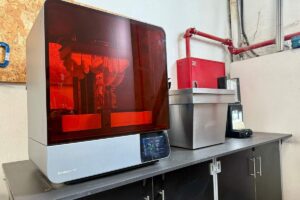
Industrial 3D printing has evolved steadily in recent years, and HP Multi Jet Fusion has established itself as the world's most advanced plastic additive manufacturing technology. Thanks to its precision, speed and ability to mass-produce functional parts, the technology has become an industry standard, used in sectors such as automotive, medical, robotics, electronics and consumer goods. In this article we tell you all about HP Multi Jet Fusion, how it works, the printer we have at Additium3D, the materials we use and why it is the technology of choice for industry. What is HP Multi Jet Fusion technology? HP Multi Jet Fusion (MJF) is a high-performance industrial 3D printing technology, based on powder sintering, which enables the production of functional parts in series with precision and speed. It is based on powder sintering, similar to SLS (Selective Laser Sintering), but with significant advantages that make it faster and more precise. While SLS uses a laser to fuse the powder layer by layer, MJF applies a fusing agent precisely to specific areas of the powder, followed by the application of heat that solidifies the particles uniformly. This allows for greatly accelerated production times and a much more uniform finish between parts. MJF technology stands out: With these features, the HP Multi Jet Fusion has established itself as the industry's most widely used choice for additive manufacturing, especially in environments where quality, repeatability and efficiency are essential. The HP Jet Fusion 5600 Series at Additium3D At Additium3D we have opted for the HP Jet Fusion 5600 Series, one of the most advanced printers in the HP Multi Jet Fusion family. This machine allows us to offer a comprehensive industrial 3D printing service for companies, from design and scanning to manufacturing and post-processing, guaranteeing high quality and precision results. The advantages of the HP 5600 include: Thanks to this printer, Additium3D is positioned as the only additive manufacturing service bureau in the Valencian Community with proprietary HP MJF 5620 technology, offering fast, reliable and scalable solutions for local and national industry. How HP Multi Jet Fusion technology works HP MJF printing is based on a very precise powder fusion process: This method allows precise results, with consistent tolerances and no deformations, even in complex geometries. In addition, the use of detailing agents facilitates the creation of parts with fine details and uniform textures, which sets it apart from other 3D printing technologies. Advantages over other 3D printing technologies Compared to other additive manufacturing techniques, HP Multi Jet Fusion offers distinct advantages: For these reasons, HP Multi Jet Fusion has become the technology of choice for automotive, medical, robotics, electronics and other industries seeking fast, precise and scalable manufacturing. Compatible materials: Arkema's Polyamide 12 S One of the main materials used in the HP MJF is Arkema's Polyamide 12 S. This polymer is ideal for industrial applications thanks to its mechanical strength, durability and thermal stability. It is also highly recyclable, allowing companies to reduce the environmental impact of their production. Polyamide 12 S can be used to manufacture: With this material, HP MJF ensures that parts are not only precise, but also functional and ready for real applications in industrial environments. HP Multi Jet Fusion applications The versatility of this technology makes it suitable for multiple industries: Thanks to HP MJF, industries such as automotive, medical or electronics can produce complex parts with uniform finishes and consistent tolerances. HP offers case studies of companies already using it in industrial environments on its resources and success stories site. HP Multi Jet Fusion models and variants The HP Multi Jet Fusion family includes several models adapted to different production levels: At Additium3D we have the HP Jet Fusion 5600 Series, which combines speed, precision and flexibility to meet the needs of our industrial customers. HP Multi Jet Fusion models feature reduced production times, improved part repeatability and the ability to produce short runs without moulds. Investing in this technology enables companies to reduce long-term costs and increase efficiency in industrial additive manufacturing. HP Multi Jet Fusion at Additium3D At Additium3D, HP Multi Jet Fusion is part of a comprehensive industrial 3D printing service, which includes: This ensures that each industrial project receives professional treatment and that the parts produced meet the highest standards. Additium3D also collaborates with high-impact projects in the healthcare sector. For example, it has participated in the development of the first prototype of a high-resolution PET brain scanner installed at the La Fe Hospital in Valencia. This project, supported by the Ministry of Science and financed with European recovery funds, enables earlier detection of neurodegenerative diseases such as Alzheimer's or Parkinson's, thanks to a more precise, sensitive and less invasive scanner. Additium3D's participation in initiatives such as this demonstrates how its expertise in industrial 3D printing and advanced technologies contributes to real innovation in strategic sectors, combining technological precision with solutions that make a difference in health and research. Power your industry with HP Multi Jet Fusion technology HP Multi Jet Fusion has revolutionised industrial 3D printing, combining speed, precision and consistency in the production of functional parts. With high-performance materials such as Arkema's Polyamide 12 S and Additium3D's end-to-end process expertise, this technology is a strategic solution for companies looking for innovation, flexibility and efficiency. Find out how HP Multi Jet Fusion can transform your industrial production and
How to prepare and submit your STL file for 3D printing in Additium 3D

If you already have your design ready, the next step is to make sure that the file is perfect so we can print it without any problems. Here I explain everything you need to know to prepare and send your STL file to Additium 3D and get the best quality in your printed piece. What is an STL file and why is it essential for 3D printing? The STL file is the standard format we use for 3D printing. This file converts your design into a mesh of triangles that the printer can interpret to produce your part layer by layer. At Additium 3D, we almost always work with STL because it is the most reliable and compatible with our equipment. What should you take into account when preparing your STL file to send it? What if you have the design in another CAD format? How to convert it to STL? If your design is in CAD formats such as STEP, IGES or DWG, you have to export it to STL before sending it. CAD programs usually have the option “Export as STL” or “Save as STL”. If you have doubts with this step, you can also send us the CAD file and we will help you to convert it so that everything is ready to print. Why is it better to send an STL instead of other formats such as OBJ? Although OBJ stores more visual information, what matters for printing is the geometry of the part, and there the STL is the king. At Additium 3D we optimise your STLs so that the print comes out perfect without losing detail. Where can you find resources to review or improve your STL file before sending it? If you want to make sure that the file is perfect, you can use free programs like Meshmixer or Netfabb Basic to fix possible bugs in the mesh. If you prefer, we will check the file before printing and let you know if we detect any problems. How to send the STL file to Additium 3D? You can send us your STL file through our contact form or by email. If the file is very heavy, we can coordinate a file transfer platform such as WeTransfer or Google Drive. When sending, always include: This helps us to give you a quick and accurate quote. Do you want to convert your STL to other formats such as DXF? If you need a 2D drawing or profile for cutting or milling, we can help you convert your STL to DXF with programs like Fusion 360 or AutoCAD. You only have to ask for it when you send us the design. At Additium 3D we take care of every detail of your file so that the printing is a success. We don't just print; we control the whole process so that the final part is exactly as you imagine it. We check the file, optimise the print and accompany you throughout the process. If you have any doubts or are not sure how to prepare your file, ask us without obligation. We are here to make your project a success.
What is mass production and how has it evolved with 3D printing?

Mass production has been one of the pillars of modern industry since the Second Industrial Revolution. Thanks to this model, companies all over the world have been able to manufacture products in large quantities, reducing costs and standardising processes. Today, with the emergence of new technologies such as 3D printing, mass production is undergoing a new revolution, especially in sectors that demand customised parts or on-demand manufacturing. Definition and concept of mass production Mass production, also known as mass production model or chain production, is a manufacturing system in which large quantities of the same product are produced through repetitive and mechanised processes. What does mass production mean? It implies that products are manufactured in a standardised way, with tasks divided into stations within a mass production line, allowing for greater efficiency and lower unit cost. When did mass production emerge? Mass production became established at the beginning of the 20th century, although its antecedents date back to the Industrial Revolution. The model became popular with Henry Ford and his assembly-line automobile manufacturing system, also known as Fordism. This revolution in industrial production allowed vehicles to be manufactured more quickly and at affordable prices, marking a turning point in the history of the industry. Characteristics of mass production The main characteristics of mass production include the following: This production system makes it possible to manufacture identical products in large quantities, guaranteeing uniform quality and more exhaustive process control. Industrial series production: our experience, advantages and limits At Additium 3D we work on a daily basis with companies that need efficient, scalable and high quality series production. From technical components for industrial sectors to functional parts for end products, we have seen first-hand how mass production is a key tool for scaling up projects and reducing costs. But we also know that it is not a universal solution: it has its pros and cons, and you have to know when to apply it and when not to. Advantages of mass production (from our experience) One of the biggest advantages we see in our work is the economy of scale. For example, when an automotive customer asked us to produce a long series of parts for functional prototypes, we were able to optimise the process thanks to good initial preparation and the use of technical materials in industrial 3D printers. The cost per unit dropped dramatically as the volume increased, making a large-scale testing phase feasible without blowing the budget. In addition, speed is a factor that is highly valued by our customers. In sectors such as product design or architecture, where we have collaborated with studios that needed to iterate versions in a short time, 3D printing allows us to deliver series of parts in a matter of days. This would be unthinkable with traditional industrial processes, which take longer to set up. Another big advantage is consistent quality. By working with advanced technology and composite materials, we can ensure that all parts in the same series maintain the same mechanical and aesthetic properties, which is essential when it comes to functional or display applications. Disadvantages (which we also experience on a daily basis) However, mass production also has its limits, and at Additium 3D we are well aware of them. A clear example is the rigidity of the system: if a client wants to introduce changes once production has started, it is necessary to adjust files, parameters and sometimes even rethink the strategy. This happens a lot in projects where the design is not yet 100% validated. Another important aspect is the initial cost. Although 3D printing avoids expensive moulds and tooling, it does require a technical set-up phase - materials, supports, orientations, validations - which takes time and expertise. We always explain this to our customers before starting series production, because not everything is “print and go”. And finally, although we work with a sustainable mindset, high-volume production can generate waste, especially when substrates are used or parts have to be discarded due to defects. That's why in every project we propose solutions to optimise materials, minimise errors and reduce the environmental footprint. In which sectors is mass production used? In a wide variety of industrial and commercial sectors, especially in those where large volumes of products need to be manufactured efficiently, homogeneously and cost-effectively. Some of the most representative sectors are: 1. Automotive industry This is one of the most emblematic sectors. In fact, mass production as we know it today emerged with Henry Ford and the production of the Ford Model T at the beginning of the 20th century. Since then, the mass production line has been perfected to produce millions of vehicles per year, while maintaining very high quality standards. Electronics and household appliances Mobile phones, computers, televisions, washing machines and microwave ovens are manufactured using mass production processes that enable large quantities of units to be brought to market quickly, reducing costs and time. 3. Food industry From beverages and canned products to snacks and frozen foods, mass production allows processes to be standardised to guarantee food safety, traceability and constant supply in supermarkets and shops. Pharmaceutical industry Medicines and medical devices require highly controlled mass production processes, with very strict quality protocols. Automation makes it possible to comply with health regulations and supply worldwide. Textile and fashion Although there is a handcrafted part in the design, the manufacture of clothing, footwear or accessories is carried out through industrial mass production, especially for large brands and fast fashion chains. 6. Furniture and furnishings Many pieces of furniture are manufactured on automated lines that allow for accurate repeat designs, speedy delivery and competitive prices. 7. Aerospace and defence Aerospace and defence combines mass production with customised manufacturing.
What is laser cutting and what types are there (CO2, 2D...)?

Laser cutting is a manufacturing technique that allows materials to be cut with incredible precision using a concentrated beam of light. It is used in sectors as varied as architecture, engineering, advertising and product design. Did you know that not all laser cutting is the same? Let's take a look at how this technology works and what types of laser cutting exist, such as CO2 laser cutting or 2D cutting. How does laser cutting work? Laser cutting is based on concentrating a high-intensity beam of light on a very small spot on a material. The heat it generates is so high that it melts, burns or vaporises the material, separating it with clean, precise cuts. All of this is controlled by computer-aided design (CAD) software, allowing parts with very complex shapes or fine details to be made. Types of laser cutting Within the world of laser cutting, there are several types depending on the technology used. The most common are: What is 2D laser cutting? 2D laser cutting is a type of cutting that works in two dimensions, i.e. on a plane. It focuses on defining contours and shapes from a sheet of material, such as a wooden board or a sheet of methacrylate. It is ideal for manufacturing flat parts, posters, templates, prototypes, decorations or models, with great speed and precision. At Additium 3D, for example, we work with 2D CO₂ laser cutting in formats of up to 1400 x 900 mm, offering impeccable finishes in both cutting and engraving. What materials can be cut with CO2 laser? The CO2 laser is extremely versatile and allows us to work with a wide variety of materials. Here are some examples: In addition, CO2 laser cutting also allows the engraving of metals, further opening up the range of possibilities for customising parts. Advantages of laser cutting Why is laser cutting so widely used? Here are some of its main advantages: Applications of laser cutting Laser cutting has applications in countless industries: Whether you need a functional part or a unique decorative element, laser cutting offers a fast, precise and cost-effective solution.
Additium 3D takes a leap forward: Selected by Lanzadera

At Additium 3D we are living a key moment in our trajectory: we have been selected to be part of Lanzadera! A boost that reinforces our commitment to offer a comprehensive 3D manufacturing solution for companies, ranging from initial consultancy to the final finishing of the parts. Innovation and additive manufacturing at the service of companies Additium 3D is not just an additive manufacturing company, we are a 4.0 manufacturing Service Bureau that accompanies companies throughout the entire production process. Our value proposition lies in offering tailor-made solutions for each client, integrating technology, innovation and sustainability. We offer a comprehensive service that includes: This combination of technologies and processes has allowed us to collaborate with top-level clients such as Etra, Viccarbe, Monrabal Chirivella, Acierta Retail, Thyssen Krupp, Hospital de la Fe and Hospital de la Ribera, and Campos Racing. We are committed to the future by developing our own 3D printing equipment At Additium 3D we are not satisfied with existing solutions. That is why we are immersed in an ambitious R&D project to develop our own large format 3D printing equipment. After years of advances and modifications, we are in the final phase of this project, which not only responds to the demands of the market, but also to the needs of the planet. In a context where sustainability and respect for the environment are essential, we have worked to make our equipment capable of printing with sustainable materials. Our future large-format 3D printing equipment will be modular and will work with organic-based bioplastics and recycled fillers, developed in collaboration with AIMPLAS. This innovation will allow us to take a definitive leap forward as a company, opening up new lines of business focused on the sale and distribution of this equipment. Furthermore, this advance is closely linked to our participation in the DECAMP research project, approved by the Valencian Innovation Agency (AVI) and promoted by AIMPLAS and IBV. Through DECAMP, we contribute as a research company, consolidating our role as a benchmark in sustainable additive manufacturing. With these new solutions, we not only reinforce our current offer, but also expand our reach, especially towards the sustainable furniture and design industry. What does it mean for us to enter Lanzadera? The Lanzadera programme is designed as an authentic high-performance centre. It is not just a space where ideas flourish, but a dynamic environment where companies receive specialised training, participate in top-level networking sessions and hold strategic meetings with mentors and industry experts. All of this is accompanied by ambitious and rigorous growth plans. As Nogueras, one of the programme managers, points out: “Lanzadera gives you a lot, but it also asks a lot of you. If you are not at the right time to take on that challenge, this is not the programme for you”. And at Additium 3D, we are more than ready. Being selected by Lanzadera is a big step forward for us, as it will allow us: The press is talking about us Our entry in Lanzadera has caught the attention of several media. Don't miss what they say about Additium 3D! Read the news in Valencia Plaza Discover the article in Levante Our appearance in Las Provincias What Expansión says about us El Español also talks about Additium 3D What next? This is just the beginning. At Additium 3D we remain committed to driving sustainable additive manufacturing for business. If you're looking to integrate next-generation 3D printing into your business or collaborate on innovative projects, let's talk. Contact us and find out how we can create tailor-made solutions for your business together.
The best 3D printing companies in Spain

When it comes to 3D printing, there is a wide range of companies offering solutions for different sectors, from prototyping to the production of customised parts. However, it is important to understand that not all companies offer the same level of service. The key difference lies in how projects are approached and the ability to offer an end-to-end solution that covers the entire process, from design to delivery of the final product. In this article, I want to explain why Additium 3D's end-to-end service is the best option for companies in all sectors and individuals looking for a complete and customised solution for their 3D printing needs. 3D printing companies vs. comprehensive 3D printing solution The 3D printing service can be divided into two broad categories: on the one hand, we find companies that offer only the manufacture of parts from an existing design, and on the other hand, there are companies like Additium 3D that provide a comprehensive solution that covers all stages of the process, from design to manufacture and after-sales advice. The traditional 3D printing service focuses primarily on the manufacture of the parts, using 3D printing technology to create objects from digital files. This type of service is suitable for companies that already have a defined design and need a quick and cost-effective solution to produce a prototype or final parts. However, this business model has its limitations: if you do not have a design or if your project requires further customisation, you cannot count on this type of company to develop the whole process. Additium 3D's end-to-end solution, on the other hand, covers the entire project lifecycle. From the moment you have an idea to the final manufacture of the parts, including customised design, technical advice, selection of materials and process optimisation. In this way, we not only ensure that the parts are manufactured with precision and quality, but we also accompany you throughout the process to ensure that the end result meets your expectations and needs. In addition, our offer adapts to any type of project, whether it is for a private individual requiring a single part or a company requiring more complex, higher volume production. Our customised approach ensures that each customer receives exactly what they need, optimising both time and resources. Additium 3D: The complete 3D printing solution for businesses in Spain Selecting the right 3D printing provider can make all the difference to the success of your projects. Unlike other companies that simply sell printers or only offer a printing service, Additium 3D offers a comprehensive service that covers all stages of the process: With Additium 3D, you don't have to coordinate multiple suppliers or buy expensive equipment: the entire process is centralised, saving time, reducing costs and ensuring consistent results. The Additium 3D end-to-end solution: What it includes and why it's the best choice At Additium 3D, we believe in the importance of offering an end-to-end solution that covers all of our customers' needs. We focus on offering a complete service from part design to final manufacturing. Here's what Additium 3D's comprehensive service includes in concrete terms: Custom design If you don't have a previous design, our team of engineers and designers will create the right model for you. Whether you need a working prototype, a customised part or a spare part, we'll help you design it from scratch. Expert technical advice At all times, you'll have the support of our experts to guide you in selecting the right materials and the best printing technology for your project. Our team will be on hand to ensure that the process is as efficient as possible. Fast, quality manufacturing 3D printing enables rapid manufacturing of prototypes and final parts. We ensure that each part is manufactured with the utmost precision, using the best techniques and materials available on the market. In addition, if your project requires a larger production run, we can scale up manufacturing without compromising quality. Variety of materials We have a wide range of materials available, from standard plastics to resins and metals, allowing us to offer solutions tailored to different needs. Whether you need a strong, flexible or high-precision part, we have the right material for you. Scalability If at any point your project needs to move from prototyping to mass production, we can adapt to your needs. 3D printing is not only ideal for small runs, but is also perfect for producing larger series efficiently. Optimised final delivery We ensure that every part is delivered on time and to the expected quality. In addition, our after-sales service offers you the support you need to resolve any questions or problems that may arise once you receive the parts. What sets us apart is that we don't just print parts; we accompany you throughout the entire process, ensuring that every stage of the project is carried out in the most efficient and cost-effective manner. No matter what industry you operate in, at Additium 3D we offer solutions that are tailored to your specific needs. When to go with an all-in-one 3D printing company like Additium 3D? Choosing an all-in-one 3D printing company like Additium 3D is the best option when you need a complete solution that covers all the phases of the project, and even when you need just one specific one. Here are some situations in which our offer is the most suitable: When you don't have a design and you need a customised part If your project doesn't have a design