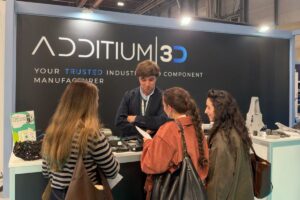




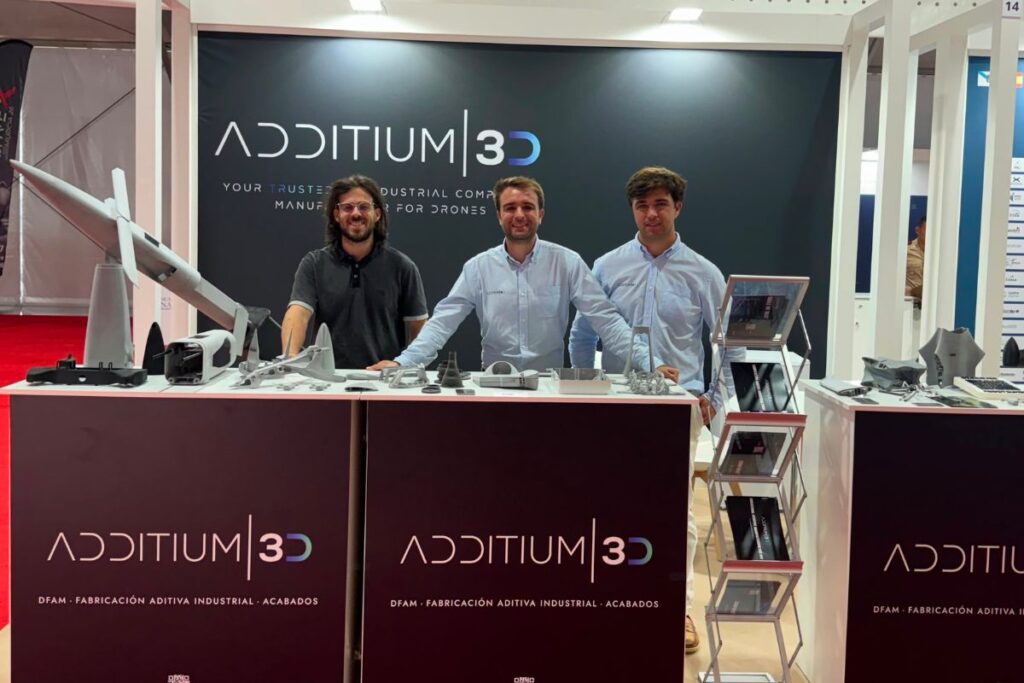
On September 16 and 17, Additium3D participated as an exhibitor at UNVEX 2026, It is one of the main meeting points in Spain for companies and professionals linked to unmanned systems.
The tenth edition was held in an environment especially linked to the sector: the former Civil Airport of San Javier, in Murcia, next to the General Academy of Air and Space.
UNVEX 2026 It brought together companies, administrations, the Armed Forces, technology centers, and experts to address the evolution of unmanned systems and dual technologies.
For Additium3D, participating in this edition had a special meaning: The UAV sector has become one of the areas in which we are most specializing our industrial additive manufacturing capabilities.
Additive manufacturing applied to the UAV sector
A drone is a system in which every gram, geometry and component counts.
Reducing weight, integrating functions, fabricating complex geometries, or rapidly modifying a part can directly influence the development and evolution of an UAV.
It is precisely there that additive manufacturing offers new possibilities for manufacturers, engineering companies and integrators.
At Additium3D we work on the Design and manufacture of plastic components for drones and UAVs, From the initial iterations to the manufacture of final parts and series.
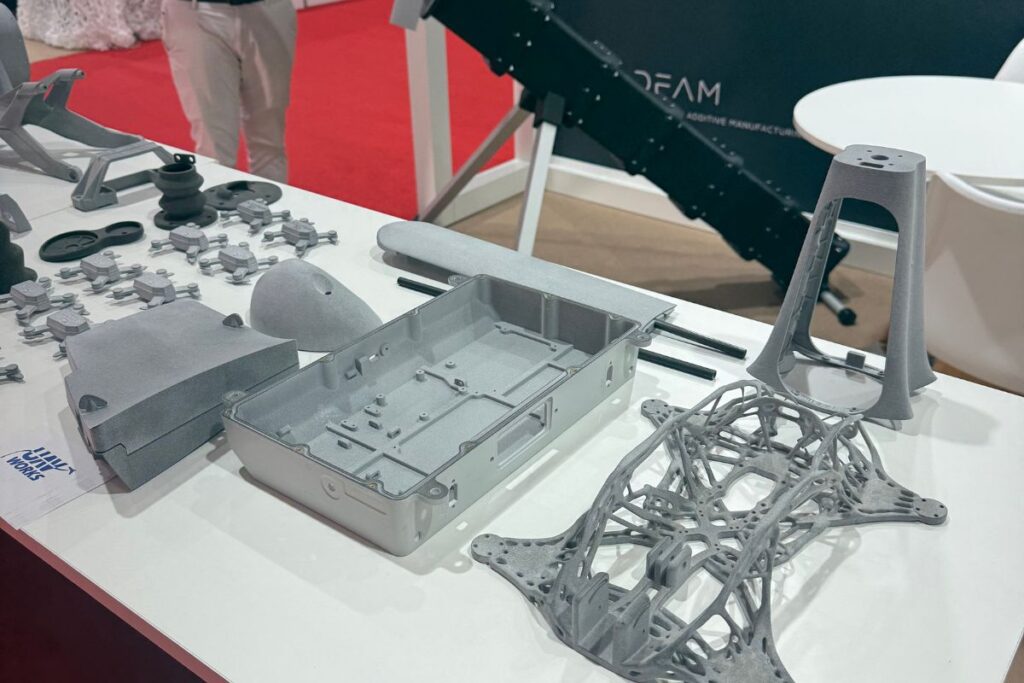
Fuselage and deckhouses, frames, housings, supports for sensors and cameras, housing for electronics, fixing systems, internal components or tools are some of the applications in which we can intervene.
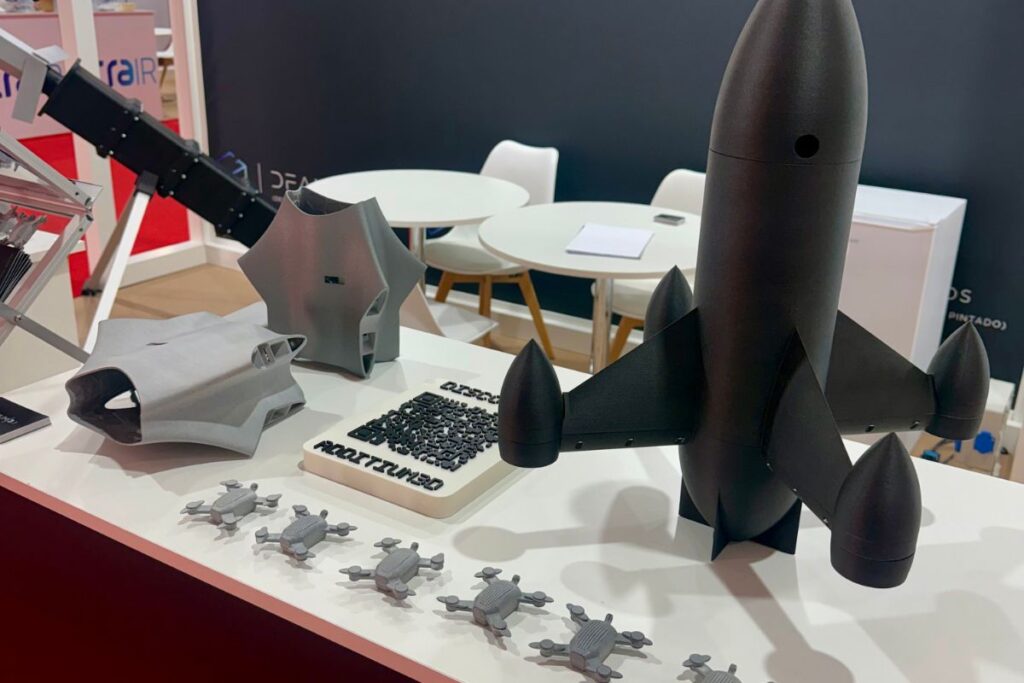
H-Wing: our own UAV to demonstrate what we can manufacture
One of the protagonists of our stand at UNVEX was H-Wing, an UAV developed by the Additium3D team itself.

The project was born with a very specific goal: to be able to show without restrictions the possibilities of additive manufacturing applied to the design and production of UAVs.
In our daily work, many of the projects are subject to confidentiality agreements. Developing our own system allows us to teach components, design decisions, and manufacturing solutions that we usually cannot showcase.
H-Wing It has been designed taking into account the possibilities of additive manufacturing from the very beginning.
Its development allows us to work on aspects such as weight reduction, the integration of functionalities within a single geometry, the design of thin walls, or the adaptation of the parts to the production process.

Designing with additive manufacturing in mind
Additive manufacturing adds much more value when it is not simply used to reproduce a part designed for another manufacturing process.
The DfAM —Design for Additive Manufacturing— It allows the component to be redesigned from its design to take advantage of the specific possibilities of these technologies.
A good example is the frame we showed at UNVEX.

Through topological optimization, it is possible to distribute the material where it is needed structurally and eliminate it in those areas where it does not provide functionality. The result are geometries that are difficult to obtain using conventional methods and especially interesting when weight is a critical variable.
MJF, FDM and different technologies for a single UAV
There is no single additive manufacturing technology suitable for all the parts of a drone.
That's why, in Additium3D works as a technology prescriptorWe first analyze what the component needs to do and, based on that, determine the most suitable process and material.
Technology HP Multi Jet Fusion (MJF) It is particularly interesting for functional components with complex geometries, element integration, thin walls, or the need for repetitive production.
On the other hand, FDM It can be a particularly competitive solution for components with larger dimensions or simpler geometries.
The ability to combine different processes within a single project allows each component to be manufactured using the technology that is truly needed, rather than having to condition the entire design to a single machine or material.

From a single piece to a manufacturing solution
Our presence at UNVEX also allowed us to showcase something that is fundamental for us: Additium3D is not just a provider to send an STL file to for printing.
We can participate from earlier phases of the project:
Design and DfAM → material selection and technology → first units → validation → iterations → production.
This is particularly interesting in the UAV sector, where designs evolve and production requirements can change quickly.
The absence of molds allows for modifying files, creating new versions, and evolving towards recurring productions without having to initially invest in the investment and rigidity associated with traditional tooling.
UNVEX 2026: a sector that is moving towards increasingly autonomous systems
UNVEX It does not focus solely on aircraft.
The meeting integrates unmanned systems from the domains air, land and sea, and its 2026 edition focused on areas such as defense, security, emergencies, artificial intelligence, autonomy, anti-drone technologies, and critical operations.
The program also included demonstrations of different unmanned systems, with solutions and operators such as TARSIS from Indra, PUMA AE from the Air and Space Force, and C-UAS systems, among others.
All of this reflects an ecosystem in which the UAV can no longer be understood solely as an aircraft: electronics, sensors, communications, software, materials, design, and manufacturing are all part of the same system.
And it is precisely in this latter part that we want to continue contributing our experience.
Additium3D as a manufacturing partner for companies in the UAV sector

UNVEX 2026 has also been an opportunity to continue getting to know projects, manufacturers, and professionals from a sector that is evolving at a rapid pace.
Our goal is clear: to continue developing the capabilities of Additium3D as Additive manufacturing partner for drone manufacturers, engineering companies and UAV system integrators.
From a first component to a recurring production, we can study each project to determine which geometry, material, and technology allow it to be manufactured in the most efficient way.
And when the project is still in development phase, we can also work on the design to take advantage of the possibilities of additive manufacturing from the very beginning.
Are you developing a drone or UAV?
If you need to manufacture components for a new UAV, optimize an existing part, or study whether additive manufacturing can fit into your production process, Tell us about your project.
We will analyze with you the geometry, material, technology, quantities, and manufacturing requirements.