

Which 3D printing material to choose depending on the type of stress on the part

Choosing a material to manufacture a part using industrial 3D printing is not simply a matter of looking for the «strongest» material. A part may be subjected to tensile stress, bending, impact, temperature, wear or repeated deformation, and each of these conditions requires different properties to be assessed. Therefore, the right material depends as much on the part’s characteristics as on the actual conditions in which it will operate. At Additium3D, we analyse these factors before defining the manufacturing solution. 3D printing technology, the material, the part’s geometry and its conditions of use must all be considered together to achieve a functional component that is suitable for the application. In this article, we review which properties should be prioritised depending on the type of stress an industrial part will endure and which materials may be suitable in each case. What should be taken into account before choosing a material? Before selecting a 3D printing material, it is important to define how the part will actually function. Manufacturing a housing is not the same as producing a structural part, a guide, a protective cover, a seal or a component subjected to high temperatures. Key factors influencing the choice include: Therefore, there is no single 3D printing material that is best for all applications. The selection must be based on the specific requirements of the part. Which 3D printing material is the strongest? This is one of the most common questions when considering the production of an industrial part using additive manufacturing. However, simply talking about «strength» can be too generic. A part may require mechanical strength, stiffness, impact resistance or the ability to withstand high temperatures. Furthermore, the final performance also depends on the geometry, the printing orientation and the technology used. Among the technologies and materials we work with at Additium3D, PAHT CF, Nylon 12 CF, PA12 S and ABS GF can meet the different requirements of functional parts and industrial applications. The choice will depend on the type of stress the component has to withstand. If the part is subjected to mechanical loads – that is, when a part has to bear loads during operation – it is important to assess properties such as mechanical strength, stiffness and dimensional stability. In such cases, engineering materials such as the following may be particularly suitable: PAHT CF PAHT CF combines a high-temperature polyamide with carbon fibre. It is designed for parts requiring high mechanical strength, stiffness, dimensional stability and good performance at high temperatures. It can be an option for functional components subjected to demanding loads. Nylon 12 CF Nylon 12 CF incorporates carbon fibre and is designed for applications requiring an engineering material with good mechanical properties. It can be used to manufacture functional parts where the aim is to combine strength and stiffness with the advantages of additive manufacturing. ABS GF Glass-fibre-reinforced ABS GF is an alternative for certain parts manufactured using FDM that require better mechanical properties than a standard thermoplastic. The choice of material will depend on the specific requirements of the application and the manufacturing process. If the part is to operate at high temperatures Operating temperature is another factor that may rule out certain materials. A part may need to operate near a heat source, be subjected to thermal cycling, or maintain its geometry and performance as the temperature rises. In such cases, it is not enough simply to select a mechanically strong material: its thermal behaviour must be specifically assessed. PAHT CF for thermally demanding applications PAHT CF is particularly suited to applications where the part must maintain good mechanical and dimensional stability under high-temperature conditions. It can therefore be an attractive option for certain industrial components subjected simultaneously to mechanical loads and thermal stresses. If the component is subject to impacts Where there is a risk of impacts or point loads, it is important to assess the material’s ability to absorb impacts without fracturing. In this type of application, impact resistance may be more important than achieving maximum stiffness. The choice will depend on the intensity and frequency of the impacts, as well as the part’s geometry and conditions of use. PA12 S, for example, is a material used in industrial additive manufacturing for functional parts and may be suitable for numerous applications where a balance is sought between mechanical performance, precision and component behaviour. If the part is subject to wear or friction Not all industrial parts withstand high static loads. Some operate continuously whilst in motion and are subject to contact, friction or wear. In these cases, it is advisable to analyse: The material must be selected taking into account how the wear occurs, not merely its initial mechanical strength. For certain functional parts of this type, engineering materials such as PA12 S, Nylon 12 CF or ABS GF may be considered, always depending on the specific operating conditions. If the part needs to be flexible There are applications where rigidity is precisely the problem. Seals, protective covers, shock-absorbing elements or components that need to deform require a material capable of withstanding such deformation without losing its functionality. TPU: when the part needs to deform TPU is a flexible and durable thermoplastic polyurethane that allows parts to be manufactured with elasticity and the ability to deform. In FDM 3D printing, it can be used to produce functional components that require: In this case, looking for the «most durable» material would be pointless: the property that defines the application is precisely flexibility. If dimensional stability is the priority In certain industrial applications, a part must not only withstand a load: it must also maintain its geometry and dimensions during operation. This can be particularly important in: In these cases, the material, manufacturing technology and geometry must be assessed together. Technologies such as MJF and SLS enable the production of complex functional parts in materials such as PA12 S, Nylon 12 or Nylon 12 CF, whilst FDM can be a suitable alternative
3D printing parts: how to know if a part is suitable for additive manufacturing

Industrial 3D printing is no longer a technology reserved for prototypes. Today, more and more companies are using it to manufacture functional parts, spare parts, jigs and fixtures, bespoke components or short runs, with excellent results. However, not all parts suitable for 3D printing are the same, nor are they all good candidates for additive manufacturing. Before choosing this technology, it is worth analysing several factors that will determine whether it really is the best option compared to other manufacturing processes such as machining or injection moulding. In this guide, we explain the main factors you should assess before manufacturing a part using 3D printing and how to determine whether your project can benefit from this technology. 1. What function will the part fulfil? The first step is to understand the part’s actual intended use. Manufacturing an aesthetic housing is not the same as producing a structural support, a production tool or a component subjected to continuous mechanical stress. The function dictates virtually all subsequent decisions: the material, the printing technology, the tolerances and even the surface finish. Therefore, before considering 3D printing, it is worth answering a very simple question: What does this part actually need to do? 2. What mechanical stresses will it have to withstand? One of the most common mistakes is to focus solely on the shape of the part and overlook the operating conditions. Before manufacturing a part for 3D printing, it is essential to analyse whether it will be subjected to: Depending on these conditions, it will be necessary to select both the most suitable technology and material. For example, materials such as PA12 S, Nylon 12 CF or PAHT CF offer excellent performance when mechanical strength and dimensional stability are the priority. 3. In what environment will it be used? The environment in which the part will operate is just as important as its design. A component used in an office is not the same as one installed in an industrial unit or exposed to the elements all year round. It is important to consider aspects such as: Each material responds differently to these conditions. For example, ASA CF is an excellent choice for outdoor parts thanks to its resistance to UV rays and weathering, whilst materials such as PAHT CF are particularly suitable for applications subjected to high temperatures. 4. Is the geometry suitable for 3D printing? Indeed, one of the greatest advantages of additive manufacturing is its ability to produce complex geometries. Internal channels, weight-saving features, organic shapes or components that previously required multiple manufacturing processes can now be produced as a single part. However, not all geometries offer advantages through 3D printing. If the part is very simple, requires thousands of units and can be easily manufactured using other processes, there are likely to be more competitive alternatives. 3D printing offers greater value when design complexity, customisation or flexibility are key factors. 5. What level of precision do you need? Each 3D printing technology offers different characteristics. That is why it is important to know the tolerances required for the part before deciding how to manufacture it. Depending on the application, technologies such as the following may be used: Choosing the right technology is just as important as selecting the material. 6. How many parts do you need to manufacture? Production volume is another decisive factor. 3D printing is particularly cost-effective for: Conversely, when large production volumes are required, other processes such as plastic injection moulding may be more competitive. Analysing the number of units from the outset allows you to choose the most efficient manufacturing process. Choosing the right material makes all the difference The same part can be manufactured using very different materials, yielding completely different results. Therefore, the material should never be chosen solely on the basis of its name or price. The important thing is to understand what the part requires and select the material that best meets those requirements. There are now specific materials available for virtually any application: choosing the right material increases the part’s service life and reduces the need for future modifications. Common mistakes when designing parts for 3D printing Many projects fail not because of the 3D printing itself, but because of incorrect decisions made during the design phase. Some of the most common mistakes are: Avoiding these mistakes from the outset saves time, costs and the need for future modifications. Checklist: Is your part suitable for 3D printing? Before starting a project, go through this list: If the answer to most of these questions is ‘yes’, it is very likely that 3D printing is an excellent solution for manufacturing your part. Do you need to manufacture a part using 3D printing? Every project has different requirements, and additive manufacturing is not always the best solution. At Additium3D, we analyse the geometry, material, production volume and actual conditions of use for each part to recommend the most suitable manufacturing technology. If you’re unsure whether a part can be manufactured using 3D printing, our technical team will advise you on finding the solution that best suits your project.
MJF vs SLS: Real Differences and When to Choose Each 3D Printing Technology
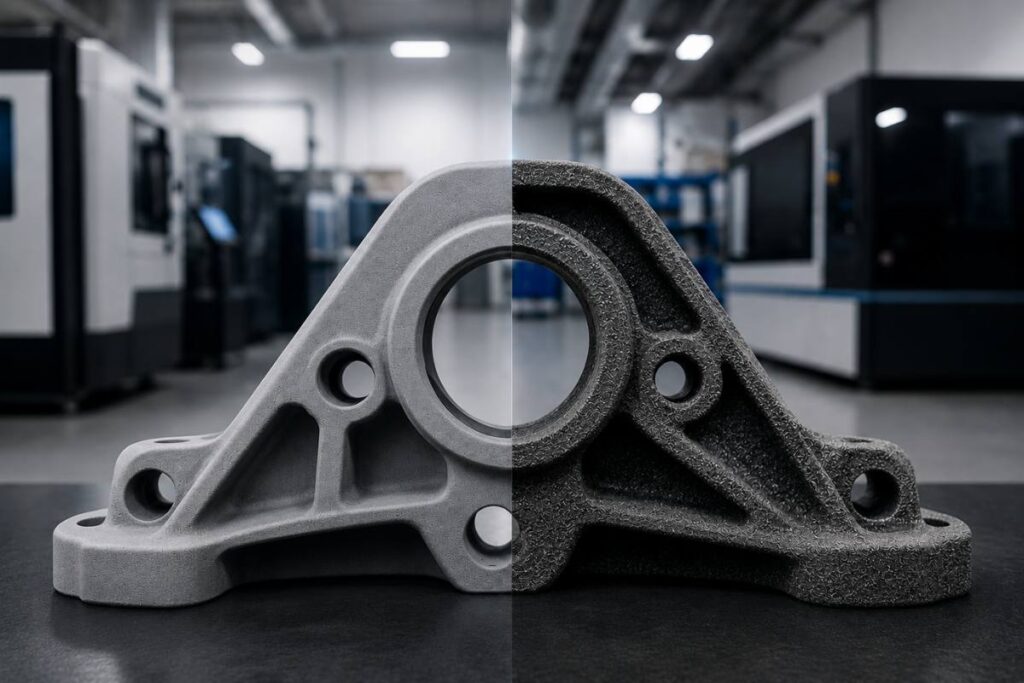
Additive manufacturing offers a range of technologies capable of producing high-quality, functional parts. However, when looking for robust industrial components, two of the most widely used options are HP Multi Jet Fusion (MJF) and SLS (Selective Laser Sintering). Both use powdered materials, allow complex geometries to be manufactured without supports, and produce final parts that are ready for use. At first glance, they may appear to be very similar technologies, but there are significant differences that affect the finish, productivity, cost and the most suitable applications for each. In this comparative guide, we analyse MJF versus SLS, explaining their advantages, differences and when it is best to choose each technology depending on your project’s requirements. What is MJF technology? Multi Jet Fusion (MJF) technology, developed by HP, manufactures parts by depositing fusion and detail agents onto a bed of polyamide powder, which is subsequently fused using thermal energy. This process enables the production of parts with high precision, excellent mechanical properties and a high production speed, making it one of the most widely used technologies for short and medium production runs. At Additium3D, we work with HP Multi Jet Fusion to manufacture high-quality functional components for a wide range of industrial sectors. If you’d like to find out more about how this technology works, please visit our page on HP Multi Jet Fusion (MJF) technology. What is SLS technology? SLS (Selective Laser Sintering) technology uses a high-power laser to selectively sinter powder particles, building the part layer by layer. Like MJF, it does not require support structures, which allows for the production of highly complex geometries and optimises the use of build volume. It is a technology particularly valued for functional prototypes, technical parts and components where a high degree of design freedom is required. MJF vs SLS: key differences Although both technologies share many characteristics, there are important differences that are worth knowing before choosing one over the other. 1. Manufacturing method The main difference between MJF and SLS is the way in which they fuse the material. MJF applies chemical agents and heat across the entire layer of powder. SLS uses a laser that scans the surface, sintering only the necessary areas. This difference affects both the manufacturing speed and the final finish of the parts. 2. Production speed If the aim is to manufacture large quantities of parts in the shortest possible time, MJF generally offers greater productivity. As it works on entire layers rather than scanning each section with a laser, it significantly reduces production times. Consequently, it is a widely used option for mass production. 3. Surface finish One of the most noticeable differences between MJF and SLS is the surface finish. Parts manufactured using MJF typically have a more uniform and consistent surface. SLS parts tend to have a slightly rougher texture, although they still offer excellent quality for industrial applications. 4. Dimensional accuracy Both technologies offer high accuracy. Both MJF and SLS are capable of manufacturing complex components with very tight tolerances, so the choice will depend more on the type of application than on the precision itself. 5. Mechanical properties Both technologies produce strong parts suitable for functional applications. However, the choice of material plays a much more important role than the technology itself. For example: MJF typically uses PA12 S, a very well-balanced material for industrial production. SLS allows parts to be manufactured using Nylon 12 or Nylon 12 CF, broadening the options when specific properties such as greater stiffness are required. 6. Design freedom In this respect, it is practically a draw. Both MJF and SLS allow the production of: All without the need for support structures. When to choose MJF? HP Multi Jet Fusion technology is usually the best option when you are looking for: It is particularly recommended for companies that need to manufacture components on a recurring basis with tight deadlines. When to choose SLS? SLS technology is particularly useful when the project requires: It is also an excellent option for validating designs before starting production. MJF vs SLS: which technology delivers better results? There is no single answer. The best technology will always depend on factors such as: In many projects, both technologies can deliver excellent results. The difference lies in which one provides greater value for the specific requirements of the part. How to choose between MJF and SLS? Before deciding between MJF and SLS, it is worth answering a few questions: Will the part be a prototype or a final product? Does it need to withstand high mechanical loads? What surface finish is required? How many units are to be manufactured? Which material offers the necessary properties? Answering these questions allows you to select the most suitable technology from the outset, optimising both the cost and the performance of the project. At Additium3D, we help you choose the right technology Choosing between MJF and SLS does not depend solely on the printer, but on the performance the part must deliver once manufactured. At Additium3D, we analyse each project to recommend the technology and material that best suit your mechanical, dimensional and functional requirements. If you’re unsure which process to use, our team can advise you on finding the most efficient solution.
3D Surgery: How Custom Surgical Guides Improve Medical Precision

3D printing is no longer a technology confined to industry; it has become a tool with a real impact on modern medicine. In recent years, hospitals, clinics and research centres around the world have incorporated additive manufacturing into their processes to improve surgical planning, reduce risks and offer increasingly personalised treatments. Among all the applications of 3D printing in surgery, one of the most significant is the production of customised surgical guides. These tools enable a digital surgical plan to be accurately transferred to the actual patient, helping specialists to perform safer, more efficient and more predictable procedures. But what exactly are 3D-printed surgical guides? How are they designed? In which medical specialities are they used? What advantages do they offer over traditional methods? In this guide, we take an in-depth look at how 3D surgery is revolutionising medical practice and why more and more professionals are turning to 3D printing to improve their clinical outcomes. What is a custom surgical guide? A surgical guide is a device designed specifically for a patient to assist the surgeon during a procedure. Its main function is to serve as a physical reference for positioning instruments, making incisions, drilling or placing implants in exact accordance with the pre-operative plan. Unlike conventional guides, custom surgical guides are designed using real medical images of the patient, usually obtained via: Thanks to this data, it is possible to create an accurate digital model of the patient’s anatomy and produce a guide fully tailored to their clinical case. 3D printing allows these components to be produced with extremely high precision and within very short timeframes, something that is difficult to achieve using traditional manufacturing methods. What is 3D surgery? 3D surgery is a surgical approach based on the use of three-dimensional models, digital simulations and customised devices developed using 3D printing technologies. The aim is to translate surgical planning from a virtual environment to the actual procedure with the highest possible level of precision. 3D surgery may include: Thanks to these tools, medical teams can anticipate difficulties, optimise procedures and tailor each operation to the specific characteristics of each patient. How surgical guides are manufactured using 3D printing The process of manufacturing a customised surgical guide combines biomedical engineering, digital design and additive manufacturing. 1. Acquisition of medical images It all begins with the acquisition of the patient’s anatomical data. Depending on the clinical case, different imaging technologies are used: These images generate digital files that allow the patient’s anatomy to be reconstructed in three dimensions. 2. Anatomical segmentation Once the data has been obtained, specialists identify and separate the relevant anatomical structures: bone, blood vessels, nerves, soft tissues, and lesions or tumours. This process is known as medical segmentation. 3. Virtual surgical planning A complete simulation of the procedure is carried out using the digital anatomical model. The medical team can define: This phase allows the surgical strategy to be optimised before entering the operating theatre. 4. Design of the surgical guide Once the planning has been validated, the customised guide is designed. The guide incorporates unique anatomical landmarks that allow for its precise placement on the patient. It may also include guide holes, depth stops, positioning surfaces and fixation systems. 5. 3D printing The guide is manufactured using high-precision 3D printing technologies. The most commonly used are: It offers excellent resolution and very precise surface finishes. It is one of the most widely used technologies for manufacturing surgical guides. Suitable for functional components requiring mechanical strength and dimensional stability. It allows the manufacture of robust and complex parts without the need for supports. 6. Sterilisation and validation Before being used in the operating theatre, the guide must pass the cleaning, validation and sterilisation protocols established for medical devices. Applications of 3D printing in surgery The applications of 3D printing in surgery are becoming increasingly widespread. They are currently used in multiple medical specialities. Maxillofacial surgery This is one of the fields where additive manufacturing has had the greatest impact. Surgical guides allow: The precision achieved significantly reduces the margin of error. Dental implantology 3D-printed guided surgery has transformed the placement of dental implants. The guides allow each implant to be positioned exactly according to the digital plan. Key advantages include: Traumatology and orthopaedics 3D-printed guides facilitate complex procedures such as: They allow the procedure to be tailored to each patient’s specific anatomy. Neurosurgery Millimetre-level precision is critical in neurological procedures. Customised guides help to: Oncological surgery In oncology, 3D printing enables the manufacture of guides for precise tumour resections. This facilitates: Cardiovascular surgery Anatomical models and customised guides help to plan complex procedures related to: Real-life cases: how 3D-printed surgical guides are improving clinical outcomes One of the main benefits of customised surgical guides is that they allow a plan previously developed in a digital environment to be carried out on the patient. Using medical images such as CT scans or MRIs, it is possible to design tools tailored to each person’s specific anatomy and use them during surgery to guide incisions, drill holes or place implants. This capability is particularly valuable in complex procedures in traumatology, orthopaedic surgery or maxillofacial surgery, where small deviations can significantly affect the final outcome. Thanks to additive manufacturing, surgeons can work with devices designed specifically for each case, improving the precision and predictability of the procedure. The experience of hospitals that have already incorporated 3D surgery into their clinical practice shows that these tools can help optimise surgical times and improve the execution of complex procedures. In this regard, orthopaedic surgeon Frederik Verstreken, from AZ Monica Hospital (Belgium), highlights that surgical guides allow for the exact reproduction of the pre-operative planning, stating that: «Our precision is much greater when we use the guides than when we do not.» Beyond precision, 3D printing is contributing to
How to manufacture obsolete parts with 3D printing

There is a fairly common problem in industry that often brings more projects to a standstill than one might think: a part breaks… and is no longer available. It could be a component for an old machine, a specific housing, a bracket, a part from a discontinued system, or a spare part that is impossible to source because the manufacturer stopped producing it years ago. And the worst part is that we’re often not even talking about a major critical part. Sometimes a small part can bring a production line, a machine or a piece of equipment to a complete standstill. Until recently, the options were quite limited: but industrial 3D printing is radically changing this situation. Today it is possible to reproduce many discontinued parts quickly, functionally and cost-effectively, even if no original drawings exist. And this is no longer an experimental process. More and more companies are using additive manufacturing to solve real-world problems relating to maintenance, operational continuity and industrial replacement. The real problem with discontinued parts When a part disappears from the market, the problem is not usually just the cost of the replacement. The real problem is everything it causes: downtime, delays, production stoppages, dependence on suppliers and loss of productivity. In many industrial settings, continuing to use older machinery remains entirely cost-effective. The problem arises when a small component is no longer manufactured and finding a replacement becomes an impossible task. This happens very frequently in: And this is where industrial 3D printing makes perfect sense. Because it allows parts to be manufactured on demand without the need for moulds, long production runs or reliance on the original manufacturer. 3D printing isn’t just for prototypes There are still companies that continue to associate 3D printing solely with models or visual prototypes. But the reality is very different. Current technologies allow for the manufacture of: Furthermore, thanks to technical materials and industrial technologies such as MJF, SLS or SLA, many of these parts can withstand: mechanical stress, temperature, vibration, wear and tear, or continuous use. That is why more and more companies are using additive manufacturing to solve industrial maintenance and replacement problems. How to manufacture a discontinued part using 3D printing One of the biggest misconceptions is thinking you need the original file for the part. Often, this isn’t necessary. There are now several ways to reproduce an old or discontinued part. 3D scanning If a physical part still exists, even if it is broken or worn, it can be scanned to generate a digital model. 3D scanning allows for the highly accurate capture of geometries, dimensions, complex shapes and technical details. This file can then be corrected and optimised before the new part is manufactured. Reverse engineering When original drawings are unavailable, the part can be digitally reconstructed using measurements and technical analysis. This is very common in: Furthermore, it often even allows for improvements to the original design. For example, reinforcing weak areas, reducing weight, optimising geometries or adapting the part to new requirements. Functional redesign In some cases, it is not necessary to copy the original part exactly. The important thing is that it fulfils the same function. Here, 3D printing offers a great deal of flexibility because it allows components to be redesigned, adapting them to the company’s actual use. And this often even improves performance compared to the original component. Key steps for manufacturing a discontinued part Although every project is different, the process usually follows these stages: 1. Part analysis The first step is to understand: Manufacturing a visual housing is not the same as manufacturing a part subjected to vibrations or temperature. 2. Digitisation or modelling Here, the 3D file is generated using: In many cases, this stage is used to correct defects or improve the original design. 3. Choice of technology and material One of the most important steps. The choice will depend on: strength, temperature, precision, finish, flexibility and end use. Choosing the wrong material can cause the part to fail quickly, even if it is perfectly manufactured. 4. Manufacturing and validation Once manufactured, the part is tested and validated in a real-world environment. Small iterations are often carried out to adjust tolerances or improve performance before manufacturing the final version. What types of parts are usually produced? Currently, discontinued parts are already being manufactured for a wide range of industrial applications. Some fairly common examples are: These are often relatively simple parts but essential for a machine to continue functioning. And this is where additive manufacturing allows the problem to be solved much more quickly than trying to source original spare parts. How to choose the right technology and material for printing spare parts Not all technologies are suitable for the same purpose. Choosing correctly depends on the actual use of the part and the environment in which it will operate. Technology Best for Advantages Limitations FDM Prototypes and basic functional parts Economical, fast and versatile Less precise finish SLA Detailed parts and fine finishes High visual precision Lower mechanical strength SLS Technical parts and complex geometries Very good strength Higher cost MJF Industrial production and functional parts Precision, repeatability and speed Requires industrial machinery Metal (DMLS/SLM) Demanding metal components Maximum strength High cost As for materials, some of the most commonly used today are: Material Typical application Characteristics ABS Enclosures and supports Impact-resistant PA12 Industrial parts Very good mechanical strength TPU Seals and flexible parts Elasticity and shock absorption ASA CF Exterior and automotive UV and weather resistance PAHT CF Demanding industries High thermal and mechanical strength Advantages and considerations before manufacturing a discontinued part 3D printing offers many advantages in this type of application, but there are also important aspects that should be assessed before manufacturing. Advantages Important considerations It is also important to bear in mind: Not all parts can be manufactured using any technology or material. That is why it is essential to analyse each case technically before manufacturing. It also allows for the improvement of parts that were constantly failing. Often, the original parts had problems: 3D printing not only allows the part to be copied. It also allows it to be improved. For example, by reinforcing certain areas, changing thicknesses, modifying geometries or using more resistant materials. This means that in some cases the new part works even better than the original. The great
How to reduce part validation times in automotive with 3D printing
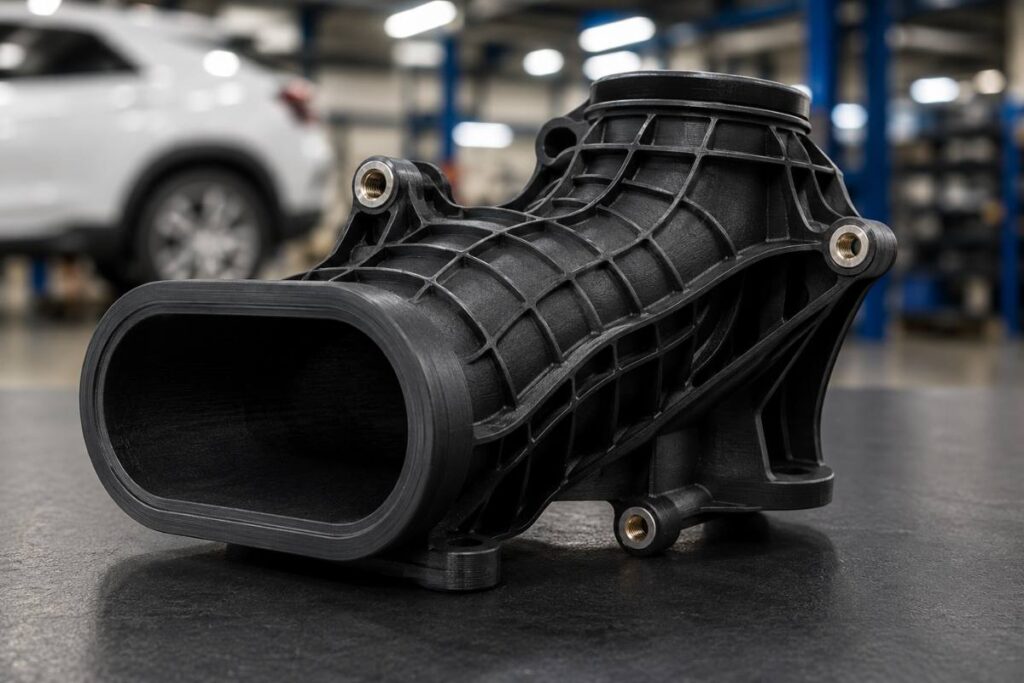
In the automotive industry, being late costs money. And often the problem isn’t in production, but much earlier on: in the validation of parts. A geometry that doesn’t fit properly, a part that requires several iterations, or an assembly that fails testing can delay an entire project by weeks. And when it comes to the automotive sector, such delays end up affecting suppliers, type approvals, production lines and launches. That is why more and more companies in the sector are using industrial 3D printing to speed up validation and reduce development times. We are not just talking about rapid prototyping. We are talking about manufacturing real, functional parts to validate earlier, detect errors sooner and make decisions much faster. And that is where additive manufacturing is completely changing the way many engineering departments work. The real problem: validating parts is still slow Many companies continue to validate components using processes designed for production, not for development. The problem is that during the validation phase, everything is constantly changing: and every small change forces processes to be repeated. When you rely on machining or temporary moulds, this can become a major bottleneck in product development: waiting times, external suppliers, cost overruns, delays and difficulty in iterating quickly. In the automotive sector, where deadlines are becoming increasingly tight, this is no longer sustainable for many projects. That is why companies are integrating 3D printing directly into their validation processes. Which parts are typically validated using 3D printing? One of the advantages of additive manufacturing is that it allows for the validation of a wide variety of components before moving to production. It is currently widely used for: It is also very common to use it for: Often, there is no need to manufacture a final part. The important thing is to quickly validate whether the design works before moving forward. And that is where 3D printing saves a great deal of time. What is really changing with 3D printing The big difference is not just the speed of manufacturing. What is really changing is the way we work. Previously, modifying a part meant resubmitting the design, waiting for production, validating, detecting errors, and starting over. Now teams can iterate much more quickly. They can test different versions almost in parallel, validate real assemblies and make technical decisions much earlier. This drastically reduces downtime during development. And it also improves something very important: the ability to react quickly. In the automotive sector, that is key. The ability to iterate quickly not only speeds up validation: it can also reduce costs and improve manufacturing efficiency. Here you can see real-world examples of how companies are applying this with 3D printing. Practical example: validation of a technical support bracket Imagine a company developing a new support bracket for an assembly line. The CAD design looks correct, but they need to check for real-world space, accessibility, strength and in-line assembly. With traditional manufacturing, it could take weeks between sourcing, machining and adjustments. With 3D printing, they can: In many cases, this saves weeks of development time. It also avoids producing moulds or final parts too early. Rapid validation has become a competitive advantage In the automotive industry, developing a part is no longer just about designing and manufacturing it. The real challenge lies in validating quickly, iterating rapidly and making technical decisions without slowing down the project’s development. There is increasing pressure to speed up launches, optimise processes and reduce lead times between design and production. This forces engineering teams to work in a much more agile way than they did a few years ago. In many projects, moreover, parts are constantly evolving during development. Geometries, materials, assemblies or technical requirements change practically on the fly. Being able to validate these modifications quickly makes a huge difference in terms of time, costs and responsiveness. This is where industrial 3D printing fits particularly well within the automotive sector. The ability to produce functional prototypes in a very short time allows real solutions to be tested earlier, errors to be detected quickly and development to move forward without relying on long or rigid processes. More than just an alternative to traditional prototyping, additive manufacturing has become a strategic tool for accelerating innovation and gaining flexibility within product development. Most commonly used technologies for validating parts Not all 3D printing technologies are suitable for the same purposes. Depending on the type of validation, some are more suitable than others. MJF (Multi Jet Fusion) This is one of the most widely used technologies in industrial automotive applications today. Why? Because it allows parts to be manufactured: It is widely used for: Furthermore, it has a major advantage: the parts can withstand real-world testing. SLS Widely used when complex geometries or lightweight technical parts are required. It allows components to be manufactured without supports and offers excellent mechanical properties. It is commonly used in: SLA When visual finish or detail is paramount, SLA is often a very good option. It is used quite a lot for: FDM Although it is a simpler technology, it is still widely used for rapid validation and initial testing. It is particularly useful when: What benefits is the industry seeing? Companies that integrate 3D printing into their validation processes often see improvements quite quickly. Particularly in: It also greatly reduces reliance on external suppliers for certain phases of the project. And something very important: it allows validation before investing in moulds or final production. This reduces risks and avoids many unnecessary costs. 3D printing does not replace automotive production; it accelerates development This is one of the most common misconceptions. 3D printing does not necessarily have to replace traditional manufacturing. What it does is accelerate critical phases of development. It helps to: In fact, many companies already use it as an essential intermediate phase before manufacturing moulds or launching final production. And an increasing number of manufacturers are turning to 3D printing solutions for automotive parts to integrate this type of rapid validation into their engineering processes. It is also being used extensively in tooling and on production lines. Beyond prototypes, many companies are using 3D printing to manufacture jigs, customised supports, templates, fixings and tools adapted to
3D Printing Materials: a Complete Guide to Choosing the Best for Each Project

The choice of 3D printing materials is, in practice, what determines whether a part works... or not. You can have a good design, good technology and even a good product idea. But if the material is not aligned with the end use, the result falls short: parts break, deformation, thermal problems or simply unnecessary costs. That's why, in industrial additive manufacturing, choosing the right material is not just another step. It is a strategic decision. In this guide we explain what 3D printing materials exist, which ones are actually used on an industrial level (as in Additium3D) and how to choose the right one for you. What are 3D printing materials and why are they key? When we talk about 3D printing materials, we are referring to the composites used to manufacture parts layer by layer using technologies such as FDM, SLA, SLS or MJF. The difference compared to other traditional processes is clear: here the material does not only influence the strength... it influences everything: In other words: the material defines the final result. And that is why, in industrial environments, it is not chosen for “what is available”, but for what the part needs. Types of 3D printing materials Generally speaking, 3D printing materials can be divided into two main groups: 1. Thermoplastics These are the most commonly used in industrial additive manufacturing. They are characterised by the fact that they can be melted and solidified several times without completely losing their properties. This makes them ideal for processes such as FDM, SLS or MJF. Examples: They are the key materials in functional production. 2. Resins (thermosets) These are mainly used in technologies such as SLA. Unlike thermoplastics, they cannot be re-melted once cured. They offer a very high level of detail and surface finish. They are ideal for: 3D printing materials most commonly used in industrial environments This is where the value really comes in: materials that are used in real projects. At Additium3D, the focus is not on “having lots of materials”, but on working with the ones that really deliver performance, reliability and scalability. FDM materials: versatility and controlled cost FDM technology is the most flexible in terms of material variety. These are the most commonly used: PLA (Polylactic acid) Perfect for design validation. ABS One of the most widely used materials in manufacturing. ABS GF (with glass fibre) Widely used in functional technical parts ASA CF (with carbon fibre) The best option when the part is going to be exposed to the environment. PAHT CF (polyamide with carbon fibre) Designed for structural or load-bearing parts. TPU (flexible) Perfect for seals, protections or flexible parts. Materials in MJF 3D printing: real industrial production When it comes to mass production, everything changes here. HP Multi Jet Fusion technology is designed to produce functional parts with high repeatability, precision and speed. And there's one key material here: Polyamide 12 S (PA12) It's the industry standard in MJF. Why? It makes it possible to manufacture everything from functional prototypes to final parts in series production. Typical applications: It's the material that makes 3D printing a real alternative to injection moulding. SLS 3D printing materials SLS technology shares the same base as MJF, but with a different approach. Here the protagonist is: Nylon (Polyamide) Ideal for: One of its great advantages is that it allows complex geometries to be manufactured without supports, which opens up many design possibilities. Materials in 3D printing SLA When the focus is on detail, precision and finish, SLA is the best option. In this case, the materials are specific resins: The most commonly used types of resins are very versatile materials, but with a focus on prototyping and validation rather than mass production. How to choose the best 3D printing material This is where many companies fail: they choose the material based on price or habit. The right way to do it is different. 1. Define the use of the part It is not the same: Each case requires a different material. 2. Analyse the actual conditions Key questions: This filters the 80% of options. 3. Think about production, not just the part An important decision: Because here everything changes. For example: Why material is key to the profitability of the project Choosing the right material doesn't just improve the part. It has a direct impact on: That's why, at Additium3D, the focus is not just on manufacturing, but on advising on the choice of the right material right from the start Because a bad decision here is paid for later. Not all 3D printing materials are the same 3D printing has evolved a lot. It is no longer just about “printing parts”, but about manufacturing to industrial standards. And that starts with a good understanding of 3D printing materials: If you make the right choice, you can reduce costs, speed up production and improve performance. If you don't, you will be limiting your own product. Do you have a project and don't know which material to choose? If you are considering integrating 3D printing in your company -whether for prototyping, product improvement or mass production- choosing the right material is the first step to ensure real results. At Additium3D we work with you from the start: we analyse your part, its end use and your business objectives to recommend not only the material, but also the most efficient technology in terms of cost, performance and scalability. If you want to validate an idea, optimise an existing part or start manufacturing without relying on moulds or large investments, tell us about your case. We can help you turn it into a viable, cost-effective and production-ready solution.
UAV components in mass production: how to scale the design and manufacture of unmanned aerial vehicles

If you're working with unmanned aerial vehicles (UAVs), you've probably been there: you have a working design, a validated prototype... but when it comes to scaling up production, the problems start. High costs, long lead times, dependence on moulds, little flexibility. And this is where many companies get stuck. Because it is one thing to design a drone... and quite another to manufacture UAV components in series production in an efficient and profitable way. Let's take a look at it with you, without unnecessary technicalities. The turning point in UAVs: from prototype to real production The growth of UAVs has been brutal in recent years. We are no longer just talking about recreational drones, but about real solutions in industry, logistics or defence, including the use of unmanned combat aerial vehicles. But there is one thing that is not always mentioned: the real challenge is not in the design, it is in the manufacturing. Because when you go from making 10 units to needing 1,000, the scenario changes completely. This is where many companies run into the same thing: And this, in a fast-moving industry, is a serious problem. Why does traditional manufacturing fall short in UAVs? It's not that injection moulding or traditional methods don't work. They work very well... but under certain conditions. The problem is that UAVs need just the opposite: this is where traditional manufacturing starts to generate friction. Conventional methods require high investment and limit the ability to iterate, which is a huge penalty in environments such as UAVs. The change of mindset: design to make better Here comes the interesting part. When you work with additive manufacturing, you don't just change how you produce. You change how you design. And this, in UAVs, makes a huge difference. Instead of designing parts with moulds in mind, you start designing with performance in mind: Additive manufacturing allows you to completely rethink UAV component development. It's no longer about adapting the design to the constraints of the process, but about leveraging the technology to optimise the product from the start. This results in lighter parts with optimised geometries and much greater functional integration. Instead of assembling multiple components, it is possible to consolidate them into a single part, reducing weight, failure points and assembly times. In fact, an engine mount is redesigned to be lighter, more efficient and easier to mass produce. This is not just design. It's strategy. Mass production without moulds: this is where it all changes Let's get to the important stuff. The big change is not in making better-looking parts. It's about being able to manufacture without relying on moulds. Because that means: And that's exactly what industrial 3D printing enables. Technologies like MJF make it possible to produce hundreds of parts in a single cycle, while maintaining quality, precision and repeatability. In other words, we are no longer talking about prototypes. We are talking about real production. The technology behind it: HP Multi Jet Fusion Within the additive manufacturing ecosystem, not all technologies are ready for mass production. In the case of UAV components, one of the most relevant is MJF. HP Multi Jet Fusion Technology is one of the technologies that really makes it possible to talk about mass production in 3D printing. Why? Because it combines three key things: It is no coincidence that it is being used in sectors such as automotive, aerospace and defence. And in UAVs it fits perfectly because it allows the production of final parts, not just prototypes. The combination of precision, homogeneous mechanical properties and manufacturability allows the production of final functional components, not just prototypes. This is key when it comes to UAVs, where parts must withstand demanding conditions and maintain reliable performance in every batch. In addition, the use of materials such as polyamide 12 provides an excellent balance between strength, lightness and durability, which is essential in aeronautical applications. Which UAV components can be mass-produced This is where many companies click. Because we are not talking about simple parts. We are talking about real functional components. Some very common examples of UAV components in series production: And all this with technical materials such as PA12, which offer mechanical strength, stability and durability for end use. Cost, efficiency and competitiveness in UAVs While traditional manufacturing requires high initial investments and large volumes to be cost-effective, additive manufacturing allows competitive costs to be achieved without that entry point. This makes it a particularly attractive solution for short and medium series, but also for continuous production in dynamic environments. In addition, there is a factor that is often overlooked: the cost of complexity. In traditional manufacturing, the more complex a design is, the more expensive it is to produce. In 3D printing, that ratio changes, allowing optimised parts to be developed without financial penalty. This opens the door to a new generation of UAVs that are more efficient, lighter and better adapted to their function. UAVs in defence: speed, adaptability and on-demand manufacturing When it comes to defence, the context changes even more. This is where UAVs come into play, where speed and adaptability are not a bonus, they are a necessity. Additive manufacturing makes it possible: This approach not only improves operational efficiency, but brings a distinct competitive advantage in environments where speed and adaptability are critical. Here you can see how this is being applied in real projects, where many companies are finding a clear competitive advantage. So... when does it make sense to use 3D printing in UAVs? Just so you're clear, there are several scenarios where it fits particularly well: If you see yourself reflected in one or more of these points, it makes perfect sense to start thinking about it. The future of UAVs is here UAV manufacturing is changing. It's no longer just about designing better, it's about manufacturing smarter. More flexible. Faster. More adaptable. And that's just what additive manufacturing enables today. No
How to reduce your company's carbon footprint without slowing down production
Promote sustainability in your manufacturing processes and reduce your company's environmental impact Sustainability is no longer an option: it is a necessity for modern business. More and more customers, investors and regulators are demanding that companies measure and reduce their environmental impact. One of the most important indicators for assessing sustainability is the carbon footprint: the total amount of greenhouse gas emissions generated directly or indirectly by a company's processes. In this article you will learn what a company's carbon footprint is, how to calculate it, examples from sectors such as transport or industrial factories, and practical strategies to reduce your company's carbon footprint without compromising efficiency or production. What is a carbon footprint and why is it important The carbon footprint measures the amount of CO₂ and other greenhouse gases that a company emits during its activity. These emissions can be direct, such as the consumption of fossil fuels, or indirect, such as the electricity you consume or the production processes of your suppliers. Calculating and reducing your carbon footprint not only helps the planet, but also brings benefits to your company: How to calculate a company's carbon footprint Calculating a company's carbon footprint is not as complicated as it sounds. It is done through an analysis of all the emissions generated by the business activity, direct and indirect. The basic steps include: Sectors with the greatest impact and examples Not all of a company's activities generate the same amount of carbon emissions. Identifying the sectors that contribute most to the carbon footprint allows prioritising actions and implementing effective solutions. Below, we review the main sectors and activities where emissions are likely to be most significant, with examples of how they can be reduced in practical ways. Industry and factories Factories typically generate a large part of a company's carbon emissions due to machinery, energy consumption and production processes. For example, the carbon footprint of manufacturing a car includes emissions from material production, assembly, energy use and transport of components. Implementing energy efficiency measures and optimising processes can significantly reduce this impact. Transport and logistics Transport is another important source of emissions. A transport company's carbon footprint can be calculated by adding up emissions from fleets, routes and fuels used. Adopting electric vehicles, optimising routes and improving loading efficiency are key strategies to reduce it. Indirect activities In addition to production and transport, other activities generate emissions: electricity consumption, waste management, corporate travel or external suppliers. Analysing these sources allows sustainable measures to be implemented throughout the value chain. How to reduce a company's carbon footprint Reducing the carbon footprint does not mean slowing down production or compromising efficiency. It is about implementing smart strategies that optimise processes, reduce emissions and, at the same time, generate benefits for the company. Here are some of the most effective actions: Energy efficiency One of the biggest contributors to any company's carbon footprint is energy consumption. Switching to LED lighting, improving insulation and optimising the use of machinery can significantly reduce emissions. In addition, incorporating renewable energy such as solar panels or certified green electricity allows you to maintain production while decreasing your environmental impact and, at the same time, reducing energy costs. Cleaner production Production generates emissions not only from energy, but also from the materials and processes used. Applying cleaner production strategies involves minimising waste, recycling materials and substituting polluting processes with less environmentally damaging technologies. For example, reusing raw materials or implementing manufacturing techniques that optimise the use of materials can significantly reduce your company's carbon footprint. Optimising logistics Transporting products and materials is another important source of emissions. Reducing transport distances, grouping shipments and using more efficient vehicles (such as electric or hybrid) can significantly reduce the carbon footprint without affecting operations. In addition, planning routes and loads intelligently helps to save time, fuel and operating costs. Digitisation of processes Digitisation of internal processes reduces unnecessary movements, duplication and errors that generate indirect emissions. Planning, production control and logistics management software can optimise workflows, minimise internal transport and improve overall efficiency. This contributes to reducing the carbon footprint while maintaining productivity. Finally, corporate culture plays a key role in sustainability. Educating staff on sustainable practices - from responsible use of resources to implementing green policies - ensures that everyone contributes to reducing emissions. A conscientious team applies changes consistently and helps identify new opportunities to optimise processes without compromising production. Benefits of reducing carbon footprint Reducing carbon footprint not only protects the planet, but also brings tangible benefits to any business. Implementing sustainable strategies can generate positive impacts on costs, reputation, compliance and growth opportunities. Reducing energy and operating costs Optimising energy consumption and adopting more efficient technologies not only reduces emissions, but also significantly reduces electricity, fuel and material costs. In addition, more efficient processes minimise downtime and waste, resulting in direct and measurable savings in daily operations. Compliance with environmental regulations and certifications More and more countries and sectors require companies to measure and report their carbon footprint. Implementing reduction strategies allows you to comply with environmental regulations, avoid penalties and obtain certifications that accredit sustainable practices, such as ISO 14001 or sustainability seals. This not only ensures legality, but also opens doors to new markets. Improved reputation and positioning Customers, suppliers and investors increasingly value sustainability. Reduce carbon footprint
5 3D printing myths holding the industry back (and why they no longer make sense)

For years, 3D printing has lived in a kind of industrial limbo. Admired for its rapid prototyping capabilities, but questioned when it comes to actual production. However, while many companies still see additive manufacturing as a laboratory tool, the global market exceeds $20 billion and its industrialisation is no longer a future promise, but an established reality. So why are only a fraction of companies using 3D printing for final parts? The answer is not in the technology. It is in the myths. Myth 1: “3D printing is too expensive for mass production” This myth stems from a simplistic comparison: price per part vs. price per part. When comparing technologies, we often only look at unit cost in large volumes. In that scenario, injection moulding seems unbeatable. But that comparison ignores the key element: the cost of entry. A technical mould can cost between 10,000 and 50,000 euros. That investment pays for itself if you produce tens of thousands of parts. But what happens when the volume is 300, 500 or 1,000 units? That's where the paradigm shifts. Additive manufacturing eliminates: When you look at total cost of ownership (TCO) and not just unit cost, industrial 3D printing is competitive at a much higher volume range than many companies imagine. Moreover, moulds are not getting cheaper. Steel, aluminium and machining processes are becoming more expensive. In contrast, the productivity of technologies such as HP Multi Jet Fusion continues to increase. The real mistake is not thinking that 3D printing is expensive. It's not crunching the numbers. Myth 2: “3D printed parts are not strong enough” This myth is a legacy of the first generations of domestic 3D printing. But today's industrial additive manufacturing works with technical materials such as: In technologies such as MJF, parts exhibit mechanical properties comparable to many injection moulded plastics, with low anisotropy and good dimensional stability. But beyond the technical data, there is something more relevant: structural freedom. 3D printing allows the design of optimised internal structures, cellular geometries, integrated reinforcements and consolidation of parts that would be impossible with traditional injection moulding. It's not just about replicating what already exists. It's about redesigning for the better. In many cases, the printed component doesn't just meet. It surpasses the original design. Myth 3: “3D printing is only for prototypes” This is probably the most limiting myth. The idea that there is a clear boundary between “prototype” and “final part” is no longer valid in industrial additive manufacturing. In technologies like MJF, the same process that produces a working prototype is the same process that produces a final part. There is no technological leap between the two phases. The difference is not in quality. It's in volume. And that's where many companies get stuck: they validate with 3D printing, but when it's time to produce, they automatically go back to the mould out of inertia. Without asking themselves if it's really the best option. Myth 4: “We've always done it this way” This is not a technical myth. It is organisational. In many companies, the flow is automatic: Design → Printed prototype → Validation → Mould. Not because it is optimal, but because it is known. The lack of real knowledge about industrial additive manufacturing is one of the biggest brakes. It is not a question of budget. It is a question of mentality. The real question should be: Does it make sense to invest in a mould for a part that changes every year? For a reference that is produced in batches of 400 units? For a product with a short life cycle? Often, the answer is no. But nobody stops the process to question it. Myth 5: “To produce in 3D, you have to buy machinery” Another common misconception. Industrial additive manufacturing doesn't necessarily require investment in your own equipment. There are specialised partners that allow you to completely outsource production, without assuming: This reduces risk and allows you to evaluate the technology with real data before making structural decisions. 3D printing does not require changing the entire organisation. It requires strategic decisions based on context and volume. The real change: from physical warehouse to digital inventory One of the most profound changes introduced by industrial 3D printing is not technical, but logistical. Traditionally, inventory is physical. Large quantities are produced to reduce unit cost and stored. But every part in storage is a gamble. If the product changes, those parts become obsolescence. Additive manufacturing makes it possible to turn the warehouse into a digital archive. Inventory ceases to be stock and becomes information. You make it when you need it. No minimums. No risk. No capital tied up. In sectors with high version turnover, this is not an incremental improvement. It is a strategic advantage. The invisible cost of not adopting additive manufacturing Not using 3D printing when it makes sense also has a cost. That cost doesn't show up on the invoice, but it does: In increasingly dynamic markets, agility is a competitive advantage. Additive manufacturing enables: And that's not a marginal advantage. It is a structural transformation. So... when not to use 3D printing? It's also important to be honest. Injection moulding is still unbeatable when: The key is not to replace injection moulding. It is to use each technology where it makes sense. The question is no longer: “3D printing or mould? The right question is: ”What volume, what complexity and how often do you change this product?“ How to make the leap without risk If your company is in that middle ground between prototype and series, the step doesn't have to be radical. Start with a reference, a component of less than 500 units, a part with lead time problems, a code that changes every year..., to compare real numbers. Not only unit price. But: The result is often surprising. Additive manufacturing is no longer the future. It is the industrial present. The market is no longer debating